

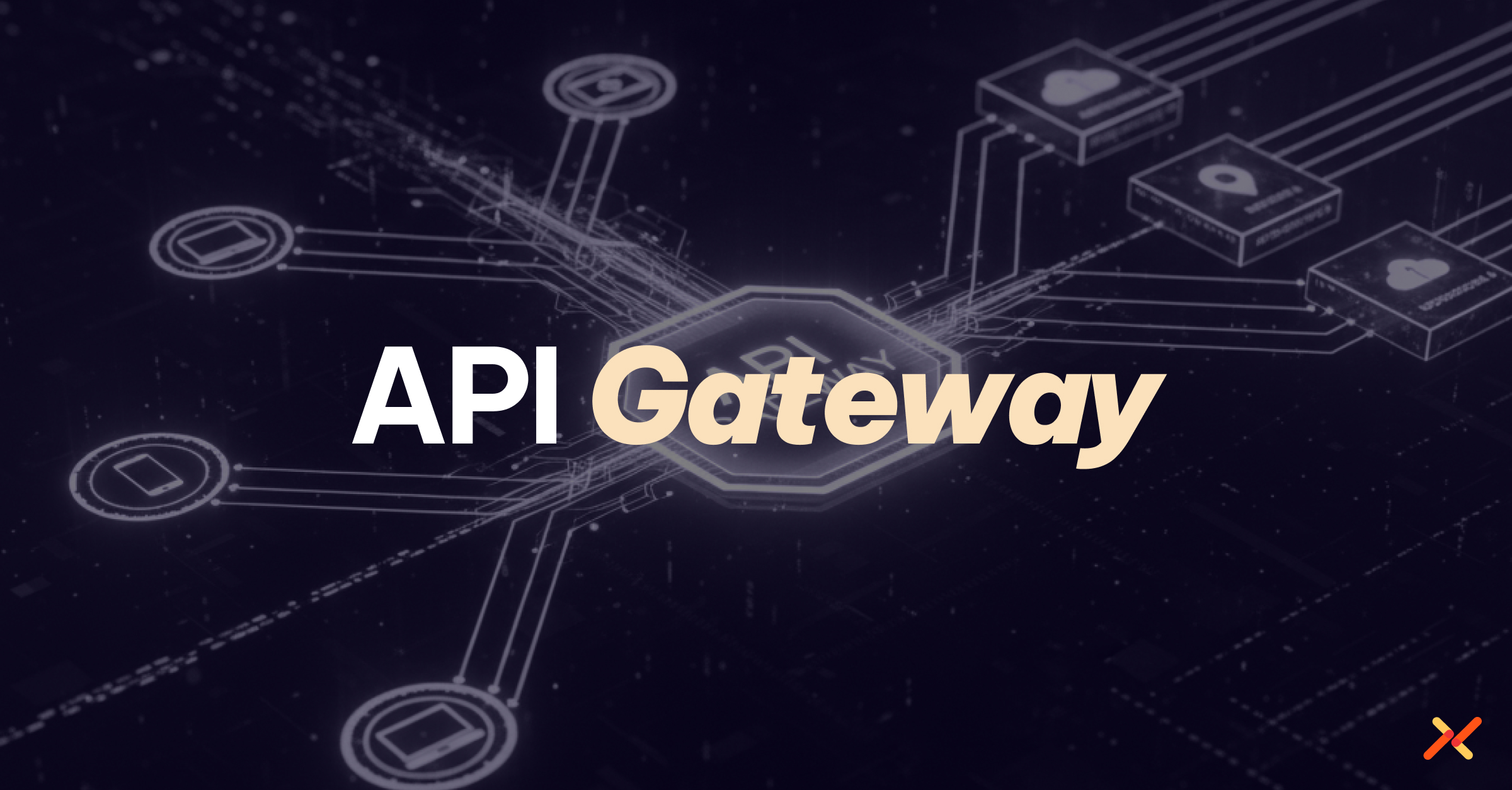
An API gateway is essentially a centralized entry point; a server that acts as the “bouncer” and “traffic cop” for all requests trying to access your company’s back-end services.
Its job is to manage traffic flow while enforcing crucial rules like authentication (checking ID), authorization (checking permissions), and rate limiting (making sure no one overwhelms the system).
How API Gateways Work
When a client makes an API request, the gateway is the first thing to intercept it before it ever reaches your back-end services. The gateway performs several checks.
It validates who the caller is (Authentication); it checks rules to see what the caller is allowed to do (Authorization); it verifies rate limits and other rules (Policy Enforcement); it sends the request to the correct back-end service (Routing); and finally, it records the entire transaction (Logging).
For example, when your mobile app requests user profile data, the gateway verifies the app’s credentials, checks the rate limit, routes the request, and logs the transaction — all before the service even starts processing.
Modern gateways are highly flexible. They can handle things like Protocol Translation (converting a REST request into a gRPC request) or Response Aggregation (combining data from multiple services into one response).
The Security Challenge: API gateway security depends on how the services (or workloads) prove their identity. A microservice requesting access must prove its identity.
Traditional methods use API keys or OAuth tokens, but these static credentials create persistent security vulnerabilities. The gateway is a critical enforcement point, but only if the identities passing through it are properly verified and tightly controlled (scoped).
For AI-driven systems, the concept is evolving into what’s called an AI agent gateway. This specialized gateway manages how autonomous agents interact with tools and data, handling complex requirements like context sharing and dynamic authorization for agents that make real-time decisions.
Why API Gateways Matter
If you run modern, modular software systems (like microservices), every time one service talks to another, it creates a potential security risk.
Without a central gateway, you run into big problems that impact security and efficiency:
- Inconsistent Security. Every team has to build its own security logic, leading to uneven policies and audit headaches.
- Credential Sprawl. Managing thousands of keys and passwords becomes chaotic across development and production environments, especially when you use multiple cloud providers.
- AI Agent Difficulty. Traditional password-based authentication can’t adapt to smart, autonomous agents that are constantly starting up and shutting down.
Common Challenges with API Gateways
Verifying workload identity across different environments: Your gateway needs to validate identities from services running everywhere; from Kubernetes containers to cloud-native functions. It must be able to apply the same rules whether the identity comes from AWS IAM, Azure Managed Identities, or Google Cloud Service Accounts.
- Credential sprawl and rotation burden: Because traditional gateways rely on static keys, teams waste time copying credentials everywhere. Rotating these keys without causing an outage becomes a massive operational burden.
- Performance and latency overhead: Checking all those tokens and rules adds a small delay (latency) at every step. At scale, this can slow down the entire application.
- Configuration drift across environments: Security needs consistent rules, but development needs flexibility. This conflict often creates different policies in development and production, which leads to exploitable security gaps.
- Limited visibility into service-to-service traffic: Most gateways are great at logging traffic entering your system, but they often struggle to log communication between your internal services. Without this full picture, you can’t troubleshoot internal issues or audit cross-service communication.
How Aembit Helps
Aembit directly solves API gateway security by eliminating static credentials from the authentication process entirely.
With Aembit:
- You can verify the machine’s identity using a digital proof (cryptographic attestation) tied to where the service is running.
- Credentials are issued temporarily and expire automatically, removing the entire burden of manual rotation and storage.
- Authorization decisions evaluate the machine’s real-time security posture before granting access.
- Every access event is logged with full context, giving security teams unparalleled visibility.
Related Reading
FAQ
You Have Questions?
We Have Answers.
Do I still need an API gateway if I'm using a service mesh?
Yes. Service meshes handle east-west traffic between services within a cluster, while gateways manage north-south traffic entering your infrastructure. The key is ensuring both enforce consistent identity verification rather than creating separate credential management schemes.
How do API gateways handle authentication for serverless functions?
Modern implementations use cloud provider identity services (AWS IAM roles, Azure Managed Identity) to authenticate serverless functions to the gateway. The gateway validates these cloud-native identities and applies policies based on function identity rather than static tokens.
What's the difference between an API gateway and an AI agent gateway?
An AI agent gateway extends traditional capabilities to handle autonomous agents that make context-aware decisions, managing tool discovery, context sharing, and dynamic authorization for unpredictable request patterns. Standard gateways simply route requests based on URLs and validate tokens.
Can API gateways create single points of failure?
Yes, if you deploy a single gateway instance without redundancy. Production deployments distribute multiple gateway instances behind a load balancer across availability zones, using identity-based authentication that doesn’t require external credential stores.