

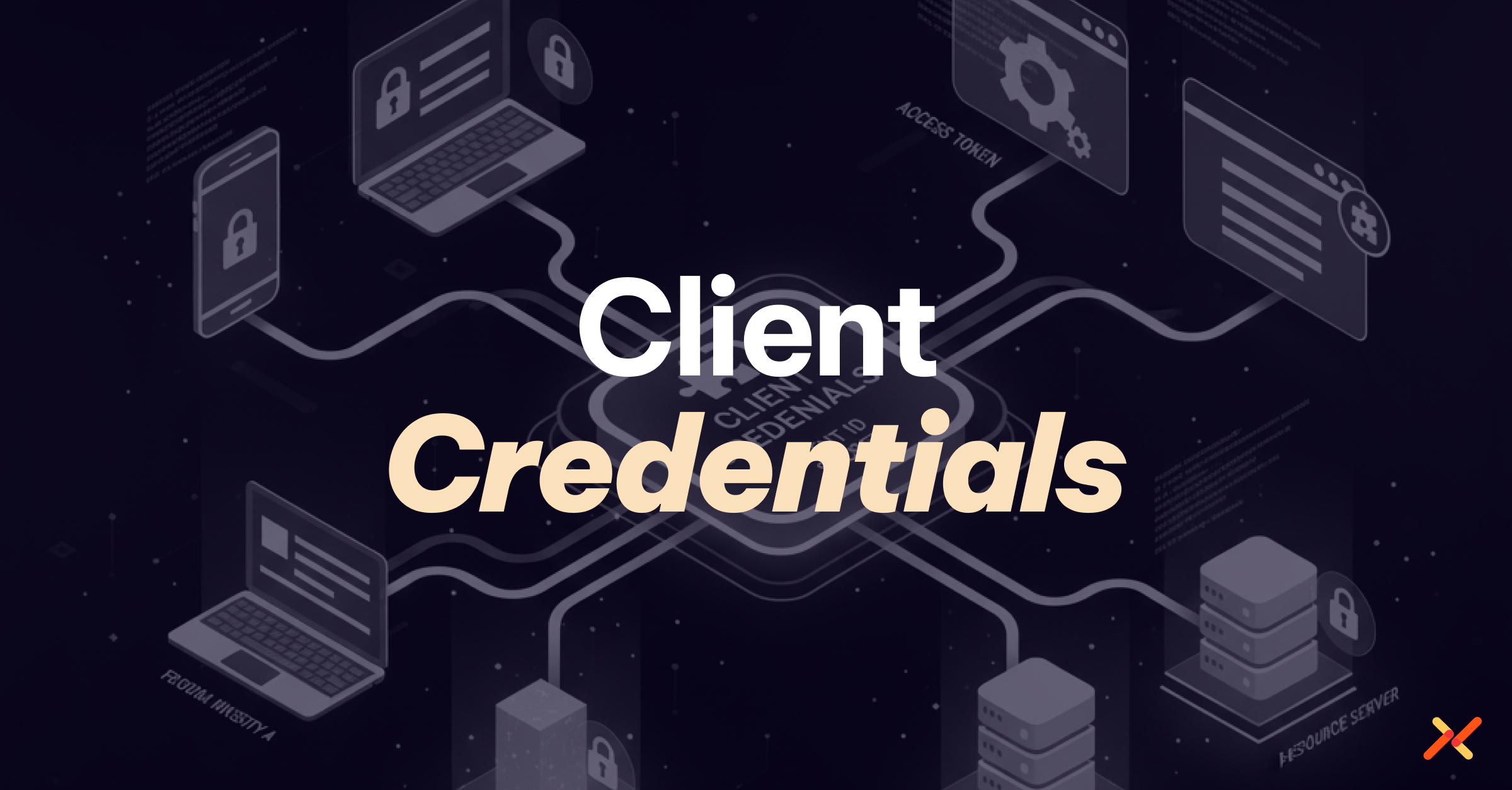
Client credentials are authentication tokens used by non-human entities (like applications, services, APIs, and automated scripts) to prove their identity and obtain access to protected resources.
Unlike user credentials that require interactive sign in, client credentials enable crucial machine-to-machine communication without any human involvement.
In OAuth 2.0, the client credentials grant type is a specific flow where a client application proves its identity directly to a server using its own credentials (usually a client ID and client secret) to receive a temporary access token.
How Client Credentials Work
Client credentials appear throughout modern infrastructure in several forms. In OAuth 2.0, they are the client ID/client secret pairs that your applications exchange for bearer tokens.
Cloud platforms use them as service account keys that workloads present to access resources like databases or storage buckets. CI/CD pipelines rely on them as API keys or deployment tokens stored in configuration files or environment variables.
The OAuth 2.0 client credentials grant flow works like this:
- A client application sends its credentials directly to an authorization server
- The server validates them and returns an access token
- The client uses this token to authenticate subsequent API requests
Kubernetes to serverless, the fundamental problem remains: how do you securely distribute, store, and rotate these credentials without creating exposure points?
This flow assumes the client can keep its credentials confidential. Storing credentials in code repositories, container images, or configuration management systems creates specific security challenges.
Why Client Credentials Matter
The rise of microservices and cloud-native architectures has created an identity crisis. Where you once managed hundreds of user IDs, you now manage thousands of machine identities, each requiring credentials.
This proliferation creates a significant operational burden:
- Security teams struggle to track where all these credentials live, who has access, and when they were last rotated.
- Developers face friction when keys expire unexpectedly or when setting up authentication for new services.
- Compliance teams often lack visibility into which workloads accessed what resources and when.
Developers face friction when credentials expire unexpectedly or when setting up authentication for new services. Compliance teams lack visibility into which workloads accessed what resources and when.
For organizations deploying AI agents that autonomously interact with enterprise systems, the stakes are even higher. These agents need access to multiple APIs, databases, and tools, each protected by different credential types. Managing static credentials for dynamic, autonomous workloads becomes both a security risk and an operational nightmare.
In environments like Kubernetes, client credentials usually live as service account tokens mounted directly into the running containers. When using serverless functions, they’re injected as environment variables or secrets when the code starts up.
Common Challenges
- Credential Exposure and Leakage: Credentials accidentally end up in public repositories, container images, or plaintext configuration files , making them easy for attackers to find.
- Rotation Complexity: Changing client credentials requires coordinating updates across every single system that uses them. The risk of downtime is so high that many companies leave credentials active for months or years.
- Lack of Context Awareness: Traditional client credentials provide binary access that can’t adapt to real-time security context like workload health, location, or time of day.
- Audit Gaps: When multiple services share one credential, determining which specific workload performed which action is impossible. This complicates incident response and compliance.
- Over-Provisioned Access: To avoid frequent credential updates, companies grant broad permissions that exceed what workloads need. This violates least privilege and increases the damage an attacker can do if they compromise the credential.
How Aembit Helps
Aembit replaces brittle, static client credentials with identity-verified, short-lived, policy-scoped access, turning a long-standing machine identity problem into a secure, automated, zero-trust workflow.
Identity is verified by environment, not by static secrets.
Aembit uses Trust Providers, such as AWS, Azure, GCP, Kubernetes, or GitHub Actions, to cryptographically attest where a workload is running and how it was deployed. This proves the workload’s identity without requiring any client credentials to be stored or shipped.
Short-lived credentials are retrieved and injected just-in-time.
Aembit Edge intercepts outbound requests, validates workload identity against policy, and retrieves the appropriate short-lived credential from a Credential Provider (e.g., AWS IAM, GCP IAM, Vault, SaaS APIs).
The credential is injected only for that request or session, never stored in repos, images, config files, or environment variables.
OAuth 2.0 client credential flows become policy-controlled and identity-aware.
For services that rely on OAuth 2.0 client credentials, Aembit brokers the token exchange on behalf of the workload.
Only workloads that pass identity attestation and conditional access checks can receive an OAuth access token, eliminating blind trust in static client IDs and secrets.
Access is governed by real-time context, not fixed credentials.
Aembit enforces conditional access policies based on identity, environment, posture, and location. Workloads receive only the minimum permissions required, and only for the duration needed, reducing the impact of credential compromise.
Every credential request and access event is fully audited.
Aembit logs each identity verification, policy evaluation, token retrieval, and access decision with complete context. This provides the visibility needed for compliance, incident response, and least-privilege governance across multi-cloud and SaaS environments.
FAQ
You Have Questions?
We Have Answers.
What's the difference between client credentials and service accounts?
Service accounts are identities assigned to non-human entities, while client credentials are the authentication tokens those identities use to prove themselves. The service account is the identity; client credentials are how that identity authenticates.
Can client credentials support multi-factor authentication?
Traditional client credentials don’t support MFA in the human sense, machines can’t respond to push notifications or enter TOTP codes. However, modern approaches implement MFA-like verification for workloads by requiring multiple factors like environment attestation, security posture validation, and cryptographic proof of identity before issuing credentials.
How often should client credentials be rotated?
Best practices recommend rotating credentials every 90 days, but this creates significant operational burden. Ephemeral, just-in-time credentials that expire after minutes or hours eliminate rotation complexity while providing stronger security than any rotation schedule can achieve.
What happens when client credentials are compromised?
With traditional static credentials, compromise means an attacker has persistent access until the credential is discovered, revoked, and rotated across all systems , taking days or weeks. With short-lived credentials, the exposure window shrinks to the token lifetime, and combined with conditional access policies, compromised credentials become significantly less valuable to attackers.