

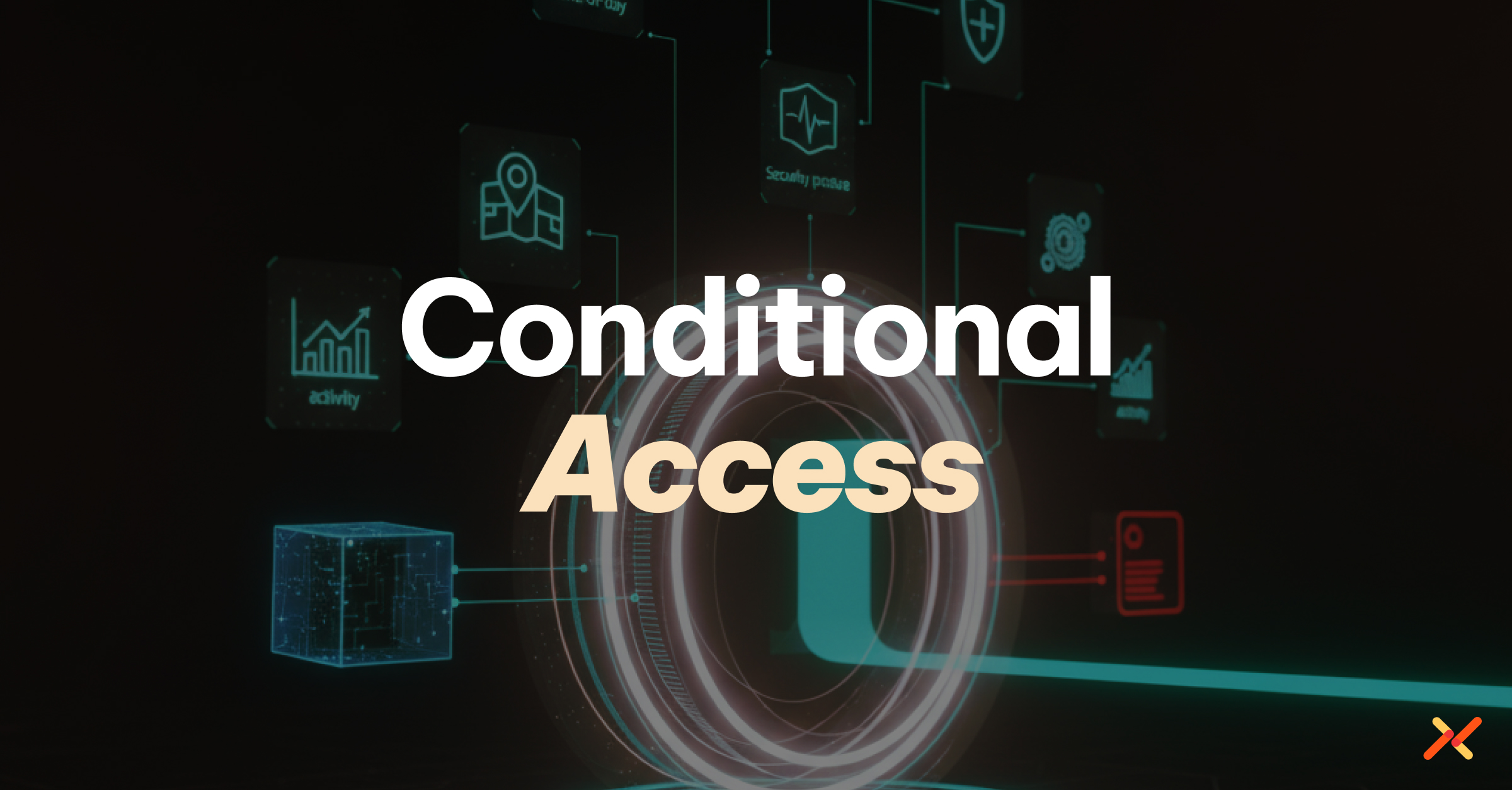
Conditional access is a security framework that evaluates real-time signals such as the program’s ID, its security health, location, and time, before granting or denying access. Instead of relying only on static passwords or keys, conditional access enforces dynamic, context-aware decisions that adapt instantly to changing risk conditions.
For organizations building zero trust architectures, conditional access is no longer optional; it’s a critical security control. This is especially true if you are managing AI agents, microservices, and hybrid cloud workloads that operate across AWS, Azure, GCP, and SaaS platforms.
How Conditional Access Works
Conditional access operates by intercepting requests at the sign-in and permission layer, checking them against a predefined set of rules.
For workloads running across any cloud, this means checking not just “who” is requesting access, but:
- From where (location),
- when (time),
- under what conditions (activity), and
- with what security posture (health)?
For example, a microservice trying to access a database might pass its ID check, but conditional access can still block the request if the program is running in an unapproved region or is trying to access data outside of business hours.
Azure Conditional Access extends this model to Microsoft environments, allowing administrators to define policies that govern access to Azure AD-protected resources based on user or workload context.
The technical implementation involves a policy engine that evaluates all these factors in real time, leading to a dynamic allow/deny decision that is logged centrally for audit and compliance.
Why Conditional Access Matters
As enterprises shift toward zero trust architectures and deploy increasingly complex workload ecosystems (including AI agents, microservices, and hybrid cloud environments), static access controls become insufficient.
While conditional access principles apply to both human and non-human identities, workload-specific implementations face distinct challenges around scale, automation, and credential elimination that traditional user-focused approaches don’t address.
A hardcoded API key or long-lived token cannot adapt when a program’s security health degrades or when it starts an unusual access pattern.
Conditional access addresses this by adding intelligence to access decisions. For the thousands of non-human identities you manage, access decisions adapt automatically to risk levels instead of relying on old permission sets. When a program is compromised or fails a health check, access revokes instantly without any manual intervention.
For AI-driven workloads, this is critical. Because an AI agent’s behavior is unpredictable, a conditional access policy ensures it accesses sensitive data only during approved hours, from verified infrastructure, and with up-to-date security validation.
Common Challenges with Conditional Access
Implementing conditional access effectively requires overcoming several obstacles:
- Identity integration across clouds: Most companies use multiple cloud and SaaS platforms, each with a different ID model (AWS IAM, Azure AD, etc.). Enforcing consistent policies across all of them is highly complex.
- Policy complexity and overlap: Without centralized management, organizations accumulate conflicting access policies that create security gaps or block legitimate access.
- Real-time posture evaluation: Many organizations lack infrastructure to assess workload posture in real time, keeping policies static when they should respond to vulnerabilities, compliance drift, or runtime behavior.
- Performance and latency concerns: Evaluating complex policies with multiple real-time checks can introduce latency into authentication flows, requiring careful balance between security rigor and operational speed.
- Audit and compliance reporting: Many organizations struggle to centralize and analyze comprehensive logs of policy evaluations and access decisions required for compliance frameworks.
How Aembit Helps
Aembit brings conditional access to workload identity at scale, enabling dynamic, context-aware access decisions for non-human identities across any environment. Rather than managing access through static credentials or manual policy configuration, Aembit evaluates real-time signals before issuing ephemeral credentials or enabling secretless access.
With Aembit:
- Policies use live vulnerability data, compliance status, and real-time behavior (integrating with tools like CrowdStrike and Wiz), automatically denying access to programs that fail security scans.
- A unified policy engine enforces consistent conditional access best practices across AWS, Azure, GCP, Salesforce, Snowflake, and other platforms, eliminating the need to define and replicate security logic in each environment.
- All policy evaluations and access decisions are logged centrally, providing complete audit trails for SOC 2, PCI DSS, and NIST SP 800-171 compliance while giving security teams visibility into workload access patterns and policy enforcement.
- Organizations implement true zero trust for machine identities by eliminating static credentials entirely and enforcing just-in-time access based on verified identity and real-time context—without adding complexity for developers or operational teams.
Ready to implement conditional access for your workloads? Connect with Aembit to see how we can help secure your non-human identities.
Related Reading
FAQ
You Have Questions?
We Have Answers.
What's the difference between conditional access and traditional authentication?
Traditional authentication answers “who are you?” by validating credentials once at login. Conditional access continuously evaluates “should you have access right now?” by checking real-time context like location, time, and security posture before every access request.
Can conditional access slow down application performance?
When implemented efficiently, conditional access introduces minimal latency—typically single-digit milliseconds. Modern platforms optimize for speed through policy caching and efficient posture provider integrations.
How does conditional access apply to serverless functions or ephemeral workloads?
Ephemeral workloads like AWS Lambda functions are ideal candidates for conditional access because they spin up and down rapidly. Rather than provisioning long-lived credentials, conditional access evaluates each invocation based on current context and issues just-in-time credentials that expire automatically.
What happens when a workload fails a conditional access policy check?
Access is denied immediately and the event is logged with details explaining why the request failed. Once the workload meets policy requirements, such as passing a security scan or moving to an approved location, the system automatically restores access without manual intervention.