

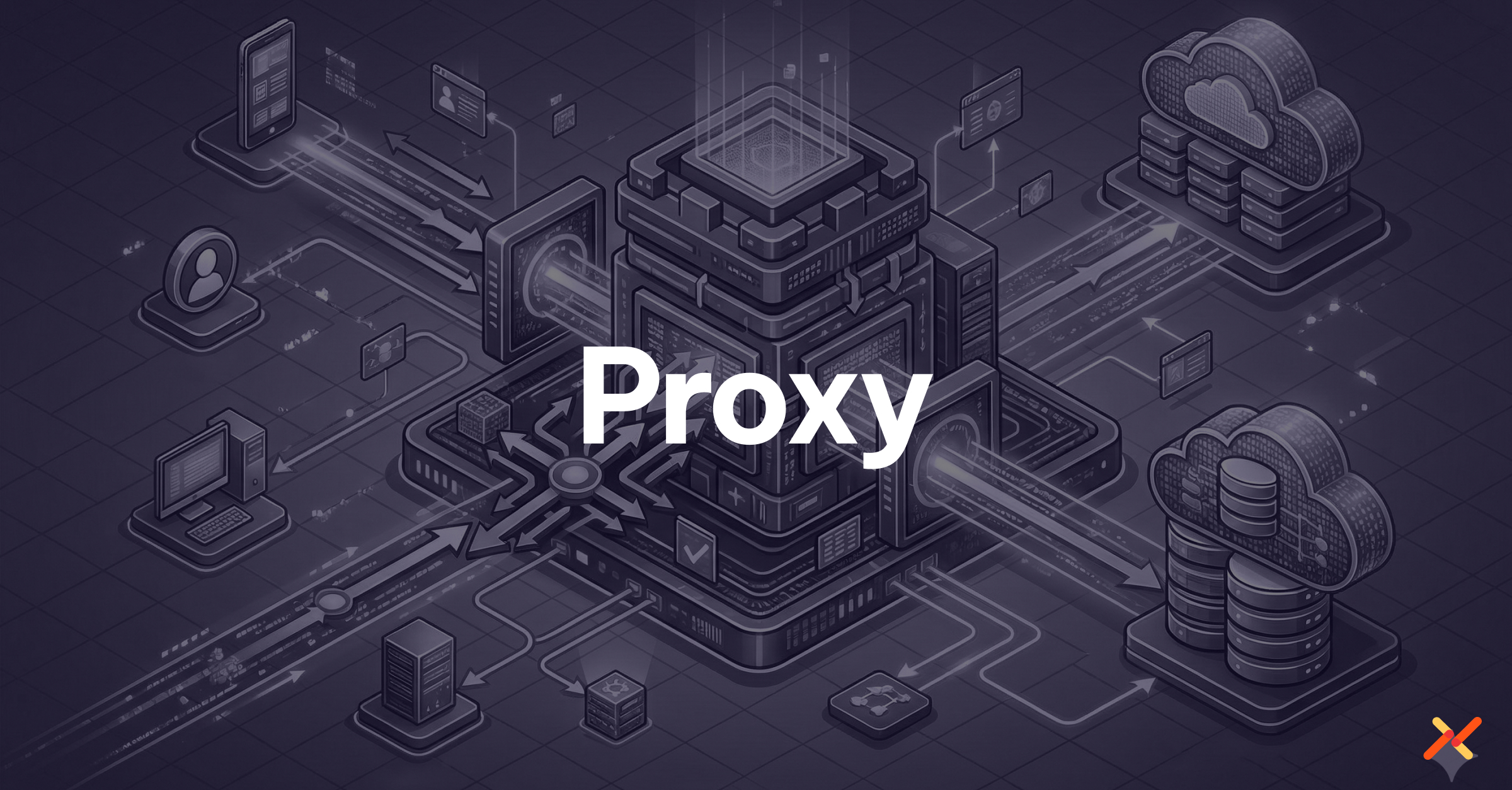
A proxy in workload identity and access management is an intermediary component that intercepts, authenticates, and authorizes requests between workloads and resources, enabling dynamic credential injection, policy enforcement, and secure communication without requiring changes to application code.
Proxies serve as policy enforcement points (PEPs) in zero-trust architectures as defined by NIST Special Publication 800-207, evaluating workload identity and context before granting access to protected resources. This proxy-based enforcement decouples policy decision-making from policy enforcement, with proxies implementing the PEP function by intercepting all access requests and communicating with centralized policy decision points to make authorization decisions.
How It Works
In modern cloud-native environments, proxies serve as PEPs that intercept access requests from client workloads before they reach server workloads or APIs. The proxy validates the requesting workload’s identity via attestation to verify identity claims, then authenticates through the complete trust-and-credential provider flow.
The proxy evaluates access policies based on access conditions derived from identity attributes and security posture, determines the appropriate credential provider for credential issuance, and transparently injects the credentials into the request. This architecture eliminates static secrets stored in code or configuration files, replacing them with short-lived, dynamically provisioned credentials bound to workload identity.
Deployment patterns vary by infrastructure. In Kubernetes environments, proxies typically run as sidecar containers deployed alongside application pods, intercepting all outbound traffic via network policy configuration or traffic steering mechanisms such as iptables rules. For virtual machine (VM) workloads, proxies deploy as lightweight agents on each VM that intercept network communication at the host level. Serverless environments use function extensions or environment variable configurations to route traffic through proxy endpoints that handle credential acquisition and injection.
Why This Matters for Modern Enterprises
Enterprises deploying AI agents, microservices architectures, and hybrid cloud workloads face exponential growth in machine-to-machine communication requiring authentication. According to NIST Special Publication 800-207 on zero-trust architecture, organizations can no longer rely on network location as a trust anchor. Every workload must continuously prove its identity and authorization regardless of where it runs.
Proxy-based authentication addresses the fundamental challenge of securing nonhuman identities at scale. When AI agents need to query vector databases, when CI/CD pipelines deploy to cloud infrastructure, and when microservices communicate across trust boundaries, each interaction requires credential management. Traditional approaches using long-lived API keys stored in environment variables or configuration files create sprawl and exposure risk. Proxies enable cryptographically verified workload identity with ephemeral credentials that exist only for the duration of each session, dramatically reducing the attack surface while simplifying operational complexity for security and platform engineering teams.
Common Challenges With Proxy-Based Authentication
Identity verification complexity presents the first major challenge. Proxies must cryptographically verify workload identity using platform-specific attestation mechanisms that differ across Kubernetes, AWS EC2, Azure VMs, and serverless functions. Organizations struggle with mapping diverse identity sources to unified access policies, particularly in hybrid environments where workloads span on-premises infrastructure and multiple cloud providers.
Certificate lifecycle management introduces operational burden. Mutual TLS (mTLS) implementations require proxies to manage X.509 certificates for each workload, including issuance, rotation, and revocation. Manual certificate management doesn’t scale beyond dozens of workloads, and improper rotation can cause service outages. Organizations need automated certificate authorities with short-lived credentials (typically one hour to 24 hours) and seamless rotation without application disruption.
TLS interception vulnerabilities create security risks when proxies terminate encrypted connections to inspect and modify traffic. According to peer-reviewed research published in the NDSS Symposium, many proxy implementations exhibit dangerous weaknesses in certificate validation, including acceptance of expired certificates and failure to verify complete certificate chains. Additionally, the research identifies that TLS-intercepting proxies often negotiate weaker protocols or cipher suites than clients would directly negotiate with servers, creating “a significant security gap” where connections become vulnerable to attacks that modern TLS versions prevent. Proxies that install custom root certificates to enable inspection create single points of compromise where attackers gaining access to root CA private keys can impersonate any service.
Performance overhead and latency impact application response times. Each request passing through a proxy adds processing time for identity verification, policy evaluation, and credential retrieval. Organizations deploying service mesh architectures with sidecar proxies report latency increases of 1-5 milliseconds per hop. In high-throughput environments with request chains traversing multiple services, cumulative proxy overhead becomes noticeable to end users.
Policy complexity and misconfiguration lead to authorization failures. As organizations define access policies based on workload identity, environment attributes, security posture, and request context, policy logic grows complex. According to the OWASP API Security Top 10 (2023), broken authorization and broken object-level authorization are leading vulnerabilities, where proxies fail to validate whether authenticated workloads have permission to access specific resources. Overly permissive policies grant excessive access, while overly restrictive policies block legitimate requests.
How Aembit Helps
Aembit Edge functions as a multiprotocol transparent forward proxy deployed alongside workloads that intercepts access requests between client and server workloads, attests workload identity using platform-native mechanisms (Kubernetes ServiceAccounts, AWS IAM roles, GitHub Actions tokens), coordinates with Aembit Cloud for policy evaluation, and injects short-lived credentials dynamically based on authorization decisions without requiring application code changes.
Organizations deploy Aembit Edge using three distinct deployment patterns tailored to different infrastructure environments. For Kubernetes environments, the agent proxy runs as a sidecar container within client workload pods using Helm chart configuration. Virtual machine deployments use a separated architecture, with the agent controller managing policy and the agent proxy intercepting traffic on workload VMs. Serverless deployments integrate the agent proxy as a sidecar container within AWS ECS Fargate tasks, using environment variables to steer traffic.
The proxy enables zero-code-change authentication through placeholder credentials. Developers use nonfunctional placeholder values in application code (such as PLACEHOLDER_API_KEY in environment variables), and Aembit Edge replaces these with real credentials at runtime before requests reach target services. This approach prevents secrets exposure in source code repositories and configuration files while maintaining developer workflow simplicity.
Aembit Edge injects credentials through environment variable replacement and protocol-specific mechanisms for many use cases, avoiding the need for TLS interception and custom root certificate authorities that create single points of compromise, as documented in TLS proxy research. All credential requests, policy decisions, and access events are logged to Aembit Cloud for centralized audit and compliance reporting, supporting frameworks including NIST SP 800-171 and SOC 2 requirements.
Related Reading
- Workload Identity and Access Management
- Ways to Steer Network Traffic to a Proxy
- 7 Ways to Authenticate Nonhuman Identities and Software Workloads to Each Other
- Why We Chose Rust
- Attestation-Based Identity: How It Works and Why It Matters Attestation-Based Identity: Hardware & Cloud Implementation
- Securing AI Agents and LLM Workflows Without Secrets
FAQ
You Have Questions?
We Have Answers.
What's the difference between a forward proxy and a reverse proxy in workload identity contexts?
In workload identity and zero-trust architectures, forward proxies and reverse proxies serve fundamentally different security roles:
Forward proxy:
- Traffic direction: Outbound (internal workloads → external services)
- Authentication model: User/service credentials with outbound access control
- Primary use case: Egress control and credential injection for outbound workload requests
- Deployment: Positioned between client workloads and external resources
- Example: Aembit Edge deployed alongside workloads to intercept outbound access requests and inject credentials
Reverse proxy:
- Traffic direction: Inbound (external requests → internal services)
- Authentication model: Identity-aware with context-based policy enforcement
- Primary use case: Inbound access control with workload identity verification
- Deployment: Positioned between external users/services and internal applications
- Example: GCP Identity-Aware Proxy (IAP) implementing zero-trust user access control with OIDC/SAML federation
According to NIST SP 800-207, the critical distinction in zero-trust contexts is the PEP implementation: forward proxies enforce policies on egress traffic based on workload identity, while reverse proxies enforce policies on ingress traffic based on user or peer workload identity. Both function as PEPs but operate at opposite trust boundaries: forward proxies protect outbound credential transmission from workloads, while reverse proxies protect inbound access to services.
Forward proxies sit between client workloads and external services, intercepting outbound requests to inject credentials and enforce egress policies. Reverse proxies sit in front of server workloads, intercepting inbound requests to authenticate clients and enforce ingress policies. In workload identity architectures, forward proxies typically handle credential acquisition for applications accessing APIs and databases, while reverse proxies (like API gateways and service mesh ingress controllers) validate incoming identity tokens and certificates. Many modern identity-aware proxies can function in both directions simultaneously, enforcing policies on both sides of the connection.
How do proxies handle certificate rotation without causing service disruption?
Modern proxy implementations integrate with certificate authorities (like SPIRE or cloud-native certificate managers) that automatically issue, rotate, and revoke certificates. The proxy maintains connections using the current valid certificate and requests a new certificate before it expires. During rotation, the proxy accepts both old and new certificates for a brief overlap period, allowing in-flight requests to complete using old certificates while new requests use updated credentials. This pattern ensures zero-downtime rotation. Organizations using service mesh architectures implement short-lived certificates with automated rotation transparent to applications, with certificate lifetimes typically ranging from 1 to 24 hours.
Can proxies enforce fine-grained authorization beyond just authentication?
Yes. According to NIST Special Publication 800-207, proxies function as policy enforcement points (PEPs) that enforce both authentication and authorization decisions. The OASIS XACML v3.0 specification defines PEPs as components that intercept access requests and enforce authorization decisions based on policies formulated with attributes about the subject, resource, action, and environment. Identity-aware proxies like GCP Identity-Aware Proxy implement “application-level access control” with “fine-grained access policies based on identity attributes,” while service mesh proxies such as Istio provide layered authorization through RequestAuthentication, AuthorizationPolicy, and attribute-based access control (ABAC) that enforce role-based and operation-level access control beyond authentication alone.
Advanced proxy implementations enforce ABAC policies that evaluate multiple factors, including source workload identity, destination resource, request method and path, time of day, geographic location, and real-time security posture from tools like CrowdStrike or Wiz. The proxy functions as a PEP that queries a centralized policy decision point for authorization decisions. For example, an authorization policy might allow a CI/CD workload to write to a production database only during approved maintenance windows when the workload has passed vulnerability scanning and originates from specific cloud regions. This granular control goes far beyond simple allow/deny based on identity alone.
What happens to proxy-intercepted traffic if the policy service becomes unavailable?
Proxy behavior during control-plane outages depends on the architectural design and risk tolerance. Fail-open configurations allow traffic to proceed without policy evaluation when the Policy Decision Point is unreachable, prioritizing availability over security. Fail-closed configurations block all traffic until policy service connectivity is restored, prioritizing security over availability. Production-grade proxy implementations typically use hybrid approaches with local policy caching. The proxy caches recent policy decisions and continues enforcing those cached policies during temporary outages. In credential injection, proxies often cache short-lived credentials and reuse them until they expire. Organizations running critical workloads deploy high-availability policy services across multiple regions with automatic failover to prevent outages from impacting application traffic.