

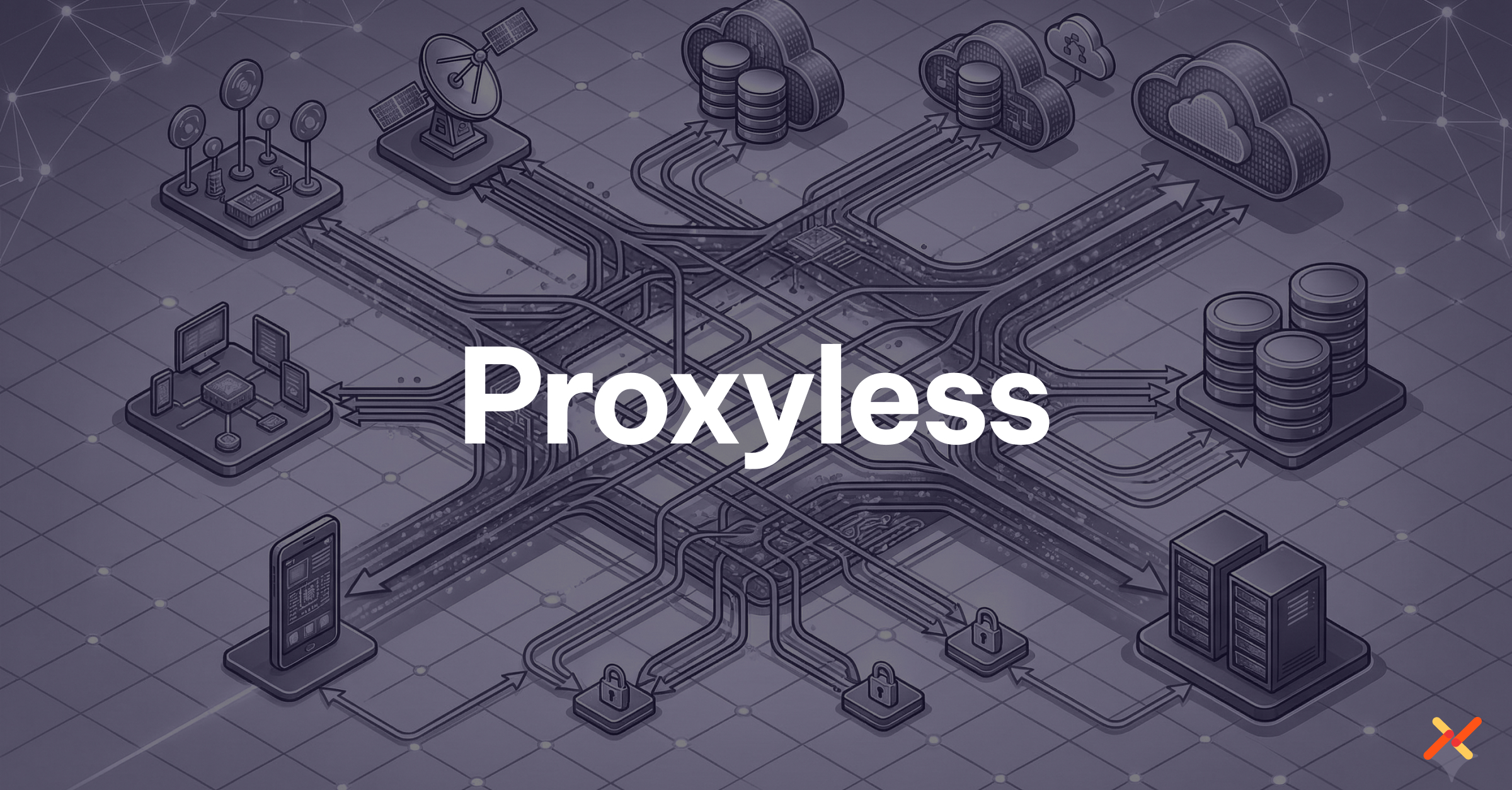
Proxyless architecture refers to workload identity and access management implementations that eliminate per-workload sidecar proxies, instead integrating security and traffic management capabilities through application libraries, kernel-level networking (eBPF) or shared infrastructure components. Service meshes represent one significant application domain for these architectural patterns.
How It Works
In workload identity and access management, proxyless implementations work through three primary patterns. Application library integration, exemplified by proxyless gRPC, embeds service mesh logic directly into gRPC libraries that communicate with the control plane via the xDS (discovery service) API for traffic management and security configuration. Kernel-level implementations leverage eBPF technology to execute networking logic directly in the Linux kernel, eliminating user-space proxy processes while maintaining Layer 4 traffic management capabilities. Sidecarless architectures replace per-pod proxies with lightweight shared proxies at the node level, separating Layer 4 traffic handling from optional Layer 7 capabilities provided by namespace-scoped proxies.
Cloud providers implement reduced-proxy credential delivery through federated identity mechanisms. AWS EKS Pod Identity uses a node-level agent approach where pods communicate with a shared agent via local HTTP endpoints to obtain temporary IAM credentials, reducing but not eliminating credential intermediaries. Google Cloud Workload Identity Federation enables workloads to exchange platform-native identity tokens for GCP access tokens through direct API calls, though these still operate through infrastructure components like API gateways and load balancers that function as proxies.
Why This Matters for Modern Enterprises
Resource efficiency becomes critical at scale. In large Kubernetes clusters, traditional sidecar proxies can consume hundreds of vCPU cores and tens of gigabytes of memory exclusively for identity and traffic management overhead. Proxyless architectures, such as node-level shared proxy models, can significantly reduce this burden, resulting inlower cloud infrastructure costs and higher pod density per node.
Proxyless architectures simplify operations by eliminating per-pod proxy lifecycle management. Sidecar-based meshes require pod restarts for all application pods to update sidecar proxy versions. Coordinating updates across distributed proxy instances, managing complex troubleshooting across hundreds or thousands of proxy logs and scaling infrastructure alongside pod multiplication create a significant operational burden. Proxyless approaches consolidate management to node-level components or application-level integration, simplifying proxy version management and reducing infrastructure overhead. However, this consolidation shifts complexity to different architectural layers: moving security boundaries to the node level increases blast radius when node-level components are compromised, while application-level approaches require tighter integration between application and mesh lifecycle.
Enterprises deploying AI agents and hybrid workloads benefit particularly from identity-based credential delivery that eliminates resource-intensive proxy overhead. AI workloads accessing language model APIs (OpenAI, Anthropic, Google Gemini) through direct credential injection mechanisms avoid the latency overhead and resource consumption of sidecar proxies while maintaining secure, just-in-time credential injection. Hybrid environments spanning on-premises data centers, multiple clouds and edge locations gain simplified identity federation through workload identity solutions that eliminate the operational burden of managing proxy infrastructure across heterogeneous platforms, supporting zero-trust architectures.
Common Challenges With Proxyless Architecture
Identity boundary shifts represent a fundamental challenge. Proxyless architectures shift security trust boundaries away from the pod level, creating different isolation patterns depending on implementation. Sidecar proxies isolate at the pod boundary, containing compromised applications to a single workload. Proxyless implementations redistribute this isolation: node-level proxy architectures use Layer 4 tunnel proxies on each node with optional per-namespace Layer 7 proxies, kernel-level eBPF implementations concentrate risk at the node level, and application runtime integrations embed security logic directly in processes. These architectural changes create different blast radius patterns. A compromised node-level proxy affects all workloads scheduled on that node, whereas eBPF kernel-level exploits could affect system-wide networking, and application-level security bypasses could affect individual services depending on implementation. In contrast, sidecar compromise is limited to a single pod, providing tighter isolation boundaries despite distributing more proxy components across the infrastructure.
Infrastructure dependencies create deployment constraints. eBPF-based proxyless implementations require Linux kernel 5.10 or later for optimal functionality (with kernel 4.9 as the minimum baseline) and demand CAP_BPF and CAP_NET_ADMIN privileges, which introduce significant kernel-level security considerations and expand the attack surface. These elevated capabilities create concentrated privilege requirements in control plane components, necessitating strict capability management and comprehensive audit logging. Application library integration couples mesh capabilities to application release cycles, requiring coordinated upgrades across development teams and increasing the burden on application developers who must maintain awareness of mesh library versions and compatibility.
Maturity gaps persist in production scenarios, though they are context-specific rather than universal. Multicluster service mesh deployments using shared node-level proxy models, while functional in proxyless configurations, remain less mature than established sidecar-based approaches, particularly for complex federation patterns. Virtual machine workload integration is functional but less mature than containerized deployments. Observability patterns continue to evolve across all service mesh architectures as the community develops best practices for monitoring and troubleshooting distributed systems, with specific challenges in aggregating per-node proxy telemetry for proxyless implementations.
Related Reading
FAQ
You Have Questions?
We Have Answers.
Does proxyless architecture eliminate all proxies from the infrastructure?
Proxyless architectures relocate proxy functionality to different deployment models rather than removing proxies completely. The term describes where proxy functionality executes, shifting it to different deployment models rather than eliminating it completely.
Some service mesh implementations use lightweight shared proxies at the node level instead of per-pod sidecars, implementing a sidecarless rather than truly proxyless model. Proxyless gRPC embeds proxy functionality directly into application libraries through xDS integration, shifting proxy logic from isolated containers to application runtime. AWS EKS Pod Identity and similar cloud-native credential delivery systems operate as agents on compute nodes rather than traditional proxies, but still function as credential intermediaries. Credential delivery mechanisms that appear proxyless often operate behind infrastructure components like API gateways, load balancers or node-level agents that function as proxies.
The distinction centers on where proxy functionality executes: in shared infrastructure (node-level shared proxies), in the kernel (eBPF-based enforcement), in application runtime (gRPC libraries) or in per-pod containers (traditional sidecars). All “proxyless” architectures retain some form of intermediary component handling policy enforcement, credential injection or traffic management. They simply relocate it from per-workload proxies to alternative deployment models.
How do cloud providers implement proxyless workload identity?
Major cloud providers have converged on reduced-proxy patterns for credential delivery through federated identity mechanisms. AWS EKS Pod Identity uses a node-level agent that pods communicate with via a local HTTP endpoint, exchanging Kubernetes service account tokens for temporary IAM credentials without sidecar injection. Google Cloud Workload Identity Federation enables cross-cloud authentication by allowing workloads to present platform-native identity tokens (AWS IAM roles, Azure managed identities, Kubernetes service accounts) and exchange them for GCP access tokens through the Security Token Service (STS) at Google APIs.
What performance improvements can organizations realistically expect from proxyless architectures?
Performance gains depend significantly on workload characteristics and existing bottlenecks. For high-throughput gRPC services with latency-sensitive requirements, academic performance benchmarks reveal architecture-dependent improvements: Cilium eBPF implementations achieve near-baseline performance with approximately 1% latency overhead, while Linkerd’s optimized Rust micro-proxy achieves only 33% latency overhead, demonstrating that proxy architecture and implementation quality, not deployment pattern alone, determine performance.
Published service-mesh benchmarks show that sidecarless implementations can achieve up to 73% reduction in latency and CPU consumption compared to sidecar deployments in controlled environments. However, well-optimized sidecar implementations like Linkerd’s Rust-based proxy demonstrate that architecture design and implementation quality significantly influence performance outcomes. Organizations should conduct controlled benchmarks in their specific environments before committing to architectural changes. Workloads with complex Layer 7 policy requirements may see diminished benefits from proxyless architectures since advanced traffic management still requires full proxy capabilities regardless of deployment pattern.
When should organizations choose proxy-based architectures over proxyless alternatives?
Proxy-based sidecar architectures remain valuable for specific scenarios with important trade-offs. Organizations requiring maximum per-workload security isolation to meet strict compliance requirements (PCI-DSS, HIPAA, FedRAMP) benefit from pod-level trust boundaries, though this comes at the cost of significantly higher CPU and memory consumption than proxyless alternatives. Heterogeneous environments with multiple programming languages gain operational simplicity from language-agnostic proxies that require no application code integration, though they sacrifice resource efficiency at scale. Multicluster and hybrid cloud deployments often rely on mature sidecar-based service-mesh tooling and operational patterns that have evolved over the years, though emerging sidecarless alternatives are closing maturity gaps. Workloads demanding sophisticated Layer 7 capabilities, including advanced traffic shaping, fault injection and protocol translation, have achieved solid coverage with established proxy implementations, though newer architectural approaches, such as namespace-scoped Layer 7 proxies, demonstrate that emerging alternatives can provide comparable Layer 7 features with significantly reduced resource overhead.