


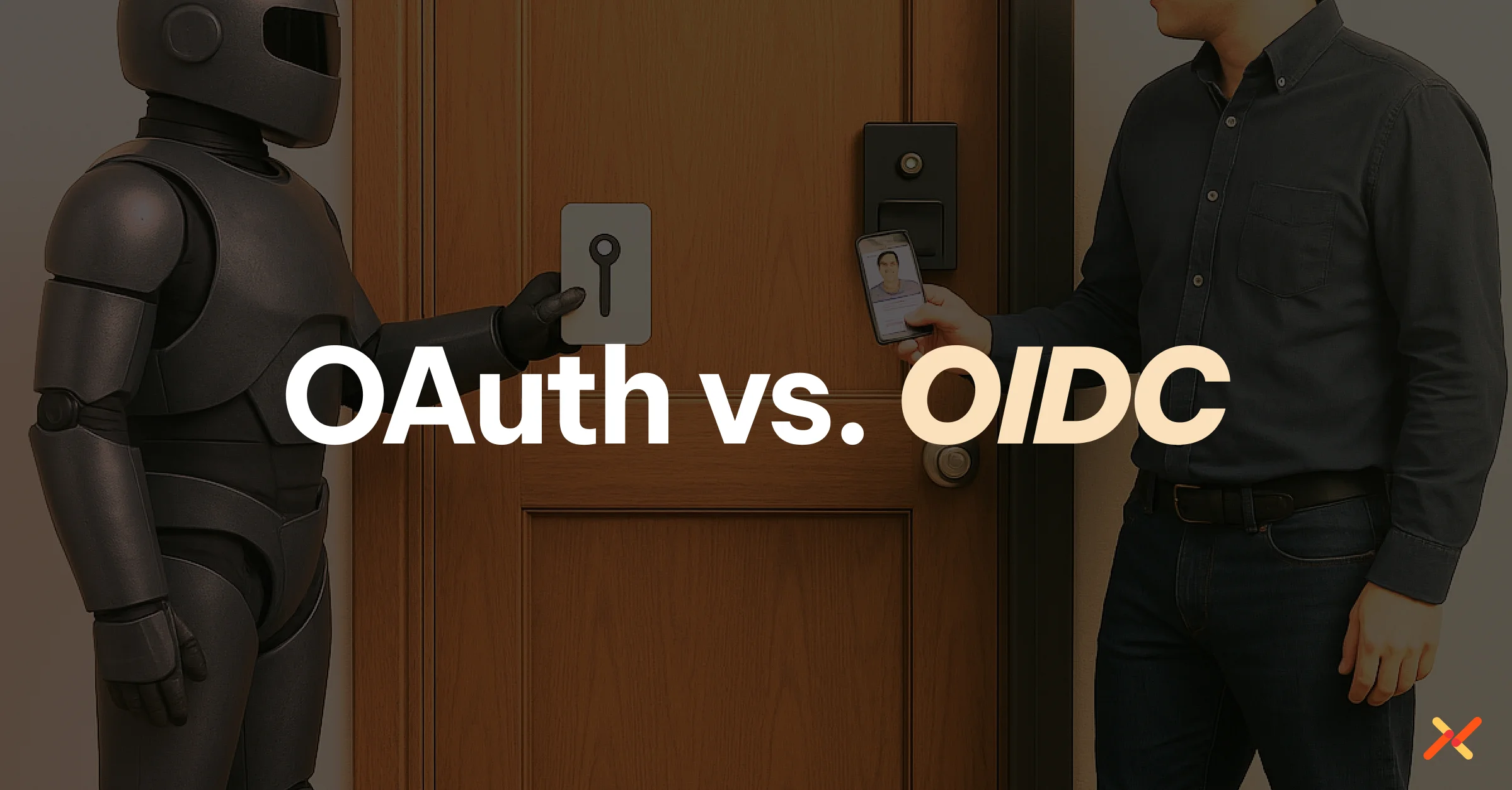
OAuth handles authorization, while OIDC handles authentication. OAuth 2.0 issues access tokens that control what an application can do, and OIDC adds an identity layer on top of OAuth that issues ID tokens confirming who is making the request. Engineers conflate the two constantly, building authentication systems when they need authorization frameworks, or parsing access tokens for identity information they should extract from ID tokens instead.
Key Takeaways
- OAuth 2.0 handles authorization, answering “what can they access,” through access and refresh tokens, and it stands alone.
- OIDC adds an identity layer on top of OAuth, answering “who are they,” through ID tokens, and it doesn’t function without OAuth underneath it.
- User-facing logins and SSO need OIDC plus OAuth together. Workloads communicating within the same trust boundary can rely on OAuth alone.
- CI/CD pipelines commonly use OIDC-based Workload Identity Federation (WIF) to obtain short-lived cloud credentials without storing long-lived cloud credentials in the pipeline.
| Protocol | Solves | Answers | Tokens Used | Stands Alone? |
| OAuth 2.0 | Authorization | What can they access? | Access and refresh tokens | Yes |
| OIDC | Authentication | Who are they? | ID token plus access/refresh tokens | No — built on OAuth |
The Core Distinction You Need to Understand
OAuth 2.0 and OIDC solve fundamentally different problems. They work together by design, but understanding when to use each requires recognizing what problem you’re actually solving.
What OAuth 2.0 Does
OAuth 2.0 provides delegated authorization. It issues access tokens that grant specific permissions to resources. The specification’s security model keeps evolving. See how it tightens these guarantees in the OAuth 2.1 guide.
What OIDC Adds to OAuth
OIDC extends the OAuth framework with an identity layer that issues ID tokens that contain claims about the authenticated user, such as user ID, email, and roles.
Key Principle: They’re Complementary
OIDC extends OAuth rather than replacing it. Most production systems need both protocols working together, as OIDC establishes who’s making the request through ID tokens and OAuth controls what they can access through scoped access tokens.
When to Use OAuth Alone, OIDC, or Both
Work through three concrete patterns to determine which protocol combination an architecture requires.
Scenario 1: Web Application User Login
When employees log into internal applications through corporate SSO, you need both OIDC and OAuth working together. Any time users are authenticating to access an application, or multiple federated applications through single sign-on, OIDC establishes who they are while OAuth scopes what they can do next.
Scenario 2: Workload-to-Workload Communication (Same Boundary)
Services communicating within the same Kubernetes cluster or cloud account can rely on OAuth alone for authorization. When workloads share a trust boundary, infrastructure-level identity verification, a service mesh, a cloud IAM role, a Kubernetes service account, already establishes who’s making the call, so OAuth only needs to scope what that already-verified caller can access.
Scenario 3: CI/CD Pipeline to Cloud
CI/CD workflows that deploy to cloud platforms require both OIDC and OAuth via Workload Identity Federation (WIF). The pipeline is crossing a trust boundary, from a CI/CD environment into a separate cloud account, so it needs OIDC-style attestation to prove which pipeline is calling before OAuth issues a scoped, short-lived token for the deployment.
A Few More Checks
A few more questions help when a request doesn’t cleanly match one of the scenarios above. If there’s no need to verify who or what is making the request, and the only requirement is controlling what can be accessed, OAuth alone suffices. If authorization depends on identity attributes such as user roles, department, email domain, or workload properties, those attributes need to come from trusted identity or policy context. ID tokens authenticate the user to the application; they should not be used as API authorization tokens. And if an application is accessing an external service on behalf of a user rather than acting as that user’s own environment, the external service manages identity verification for its own users. That’s the classic three-legged OAuth (3LO) pattern of delegated access; see 3-Legged OAuth (3LO) Explained for how that flow works.
Match Your Protocol Choice to Your Security Requirements
Each protocol combination requires specific validation steps to ensure secure authentication and authorization.
OAuth Alone: Validation at the Resource Server
When using OAuth alone, validate access tokens at each resource server with these checks:
- Token signature
- Expiration and scopes
- Audience claim
OIDC + OAuth: Validate Both Token Types
When using OIDC plus OAuth, validate each token type according to its purpose: ID tokens and access tokens.
Use the Right Token for the Right Job
Each token type serves a specific purpose in the authentication and authorization flow. Most ID and access tokens are implemented as JWTs; see JWT vs. OAuth for how the token format and the protocol relate to each other.
| Token Type | Purpose | Validated By |
| ID Token (OIDC) | Prove identity to application | Application |
| Access Token (OAuth) | Authorize API access | Resource server |
| Refresh Token (OAuth) | Get new access tokens | Authorization server |
When to Use Workload Identity Federation
WIF allows workloads running in one environment to authenticate and access resources in another environment without managing long-term credentials.
Implement the Right Protocol With Ease
OAuth and OIDC work together by design, with OIDC extending OAuth’s authorization framework to include identity verification. Choosing the right combination depends on the use case: OIDC plus OAuth for user-facing applications that need both identity and authorization, and OAuth alone for workloads within the same trust boundary, where the infrastructure already establishes identity.
The CI/CD-to-cloud pattern in Scenario 3 is where this gets hardest to implement well. Workload Identity Federation lets a CI/CD pipeline prove its identity to a cloud provider through a preconfigured trust relationship, without storing a long-lived cloud credential in the pipeline configuration. Aembit’s Workload IAM platform verifies that pipeline’s identity through cryptographic attestation instead, enforces policy-based access control on what it can reach once verified, and removes the static credentials WIF is meant to eliminate in the first place. Whether that’s a CI/CD workflow deploying into a cloud account or any other pipeline-to-cloud handoff, Aembit maintains the separation between authentication and authorization that OIDC and OAuth are each responsible for, without a secret sitting in a pipeline configuration to leak. Request a demo to see how secretless workload access works for your architecture.
Related Reading
FAQs
What's the difference between OAuth and OIDC?
OAuth 2.0 handles authorization, controlling what an already-identified party can access through scoped access tokens. OIDC adds an identity layer on top of OAuth that handles authentication, issuing ID tokens that state who made the request. OIDC doesn’t function without OAuth underneath it; OAuth can run without OIDC when identity doesn’t need to be established.
Can you use OAuth without OIDC?
Yes. OAuth alone works whenever the caller’s identity is already established by something else, such as workloads communicating within the same Kubernetes cluster or cloud account. In that case, the infrastructure handles identity verification and OAuth only needs to scope what the caller can access.
Can you use OIDC without OAuth?
No. OIDC is built directly on top of OAuth 2.0 and depends on OAuth’s authorization code flow to issue its ID token alongside an access token. There’s no OIDC deployment that doesn’t also involve OAuth running underneath it.
Do CI/CD pipelines deploying to the cloud need OIDC and OAuth?
Yes, typically through Workload Identity Federation. The pipeline is crossing a trust boundary into a cloud account it has no pre-existing relationship with, so it needs OIDC-style attestation to prove which pipeline is calling before OAuth issues a scoped, short-lived credential for the deployment.
What's the difference between an ID token and an access token?
An ID token is an OIDC artifact that proves identity to the application itself, containing claims like user ID, email, and roles. An access token is an OAuth artifact that a resource server validates to authorize a specific API call. The application reads the ID token; the resource server reads the access token.
Is a JWT the same thing as OAuth or OIDC?
No. JWT (JSON Web Token) is a token format, not a protocol. OAuth and OIDC both commonly issue their tokens as JWTs, but the protocols define what a token means and how it’s obtained, while JWT just defines how the token is structured and signed.


