

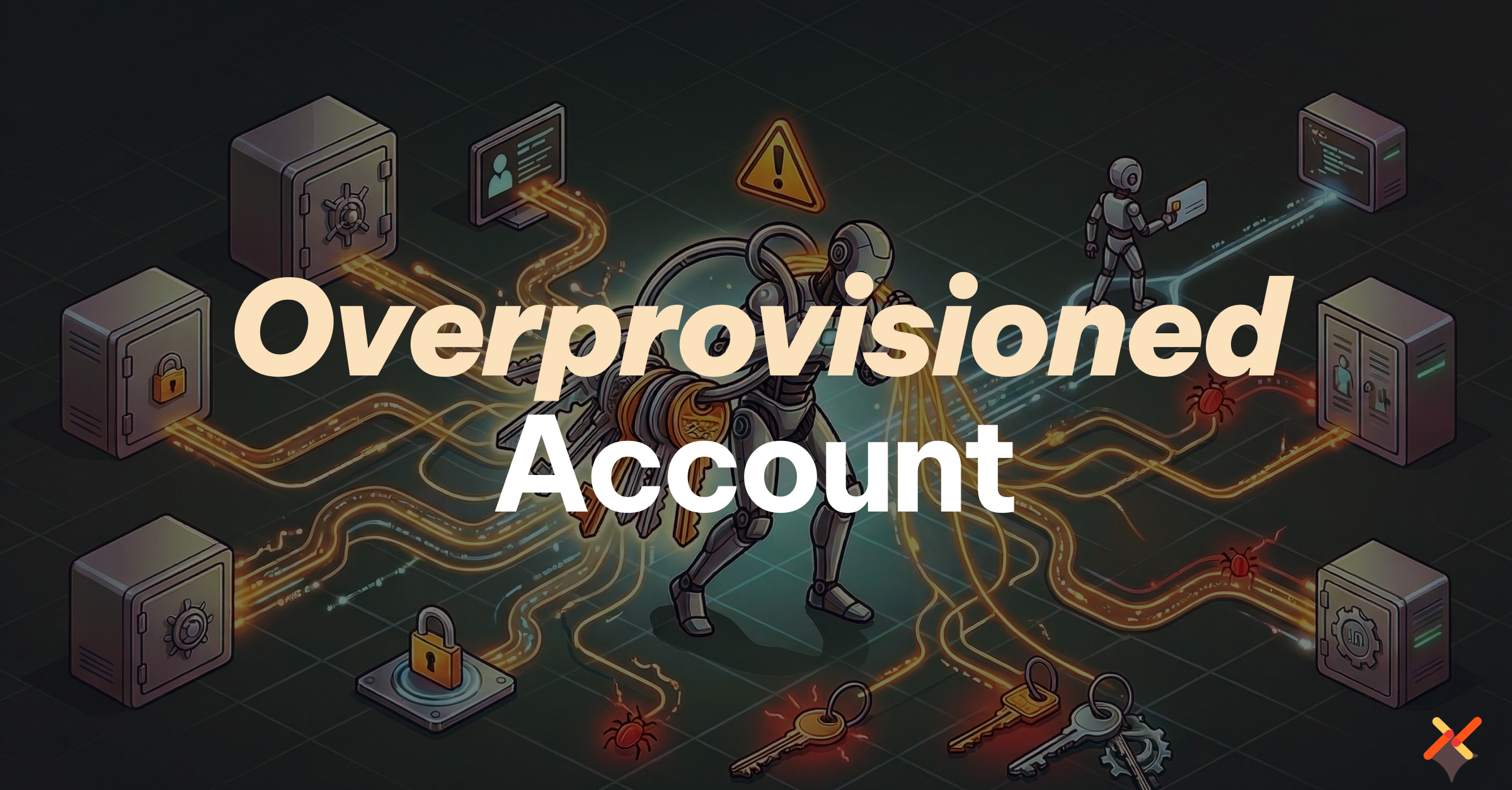
An overprovisioned account has more access privileges than necessary for its role or function. In cloud security and workload identity management, this occurs when service accounts, applications, CI/CD pipelines, or other nonhuman identities are granted broader permissions than required for their operational tasks, creating security vulnerabilities that attackers can exploit for lateral movement and privilege escalation. This violates the fundamental security principle of least privilege.
How It Works
Overprovisioned accounts are typically created through convenience-driven identity assignment and then persist due to weak lifecycle controls. The problem begins at provisioning time and compounds as environments scale.
In cloud platforms, service accounts, roles, and managed identities are often granted broad permission sets during initial setup to ensure workloads function without access errors. Engineers commonly assign predefined roles such as Owner, Editor, or cluster-admin instead of defining narrowly scoped permissions, especially when deployment timelines are tight. Once the workload is operational, these permissions are rarely revisited or reduced, even as the workload’s actual access needs stabilize or shrink.
In Kubernetes environments, overprovisioning frequently originates from default behaviors and misconfigured RBAC. Service accounts may automatically receive API tokens and be bound to high-privilege roles, allowing pods to interact with the Kubernetes API beyond what is required for their function. Namespace-scoped workloads are often granted cluster-wide permissions, enabling access to unrelated resources and control-plane operations. These permissions remain active for the lifetime of the service account unless explicitly revoked.
In CI/CD systems, pipelines accumulate excessive privileges as access requirements evolve. Build and deployment jobs are commonly granted long-lived credentials or cloud roles that allow broad read and write access across environments. When new steps are added to pipelines, permissions are expanded incrementally rather than rescoped. Because these credentials are noninteractive and difficult to audit, they often remain valid long after their original purpose has changed or expired.
Serverless functions and containerized workloads experience similar drift. IAM roles attached to functions or workloads are reused across services, environments, or teams, leading to permission reuse that exceeds actual runtime needs. Without automated enforcement of least privilege or time-bound access, these roles persist as standing privileges rather than being issued dynamically per request or execution.
Over time, overprovisioned accounts become high-value attack targets. If a workload is compromised, the attacker inherits all granted permissions, enabling lateral movement, privilege escalation, and access to unrelated systems. The lack of continuous access evaluation and automated deprovisioning allows these excessive permissions to remain exploitable indefinitely, violating least-privilege principles central to modern workload IAM models.
Why This Matters for Modern Enterprises
Cloud-native architectures have fundamentally changed the identity landscape. Nonhuman identities, including microservices, containers, functions, and automation workflows, now require their own identities and credentials, creating significant sprawl in cloud environments. Each microservice, container, function, and automation workflow requires its own identity and credentials. This explosion of machine identities means that overprovisioning isn’t just a security problem affecting a few administrator accounts. It’s a systemic vulnerability affecting thousands or tens of thousands of workload identities across an enterprise.
The financial impact is measurable. According to Oasis Security research, breaches involving compromised static credentials (the most common form of overprovisioned access) cost organizations an average of $4.81 million and require 292 days to contain, the longest remediation timeline among all attack vectors. The 2019 Capital One breach demonstrates the real-world consequences: an overly permissive IAM role attached to an EC2 instance (not a web application firewall) enabled attackers to access and exfiltrate data on over 100 million customers after exploiting a server-side request forgery vulnerability.
For enterprises deploying AI agents and hybrid workloads, the challenge intensifies. AI agents require access to multiple data sources, APIs, and services. Each connection point represents a potential overprovisioning risk if credentials grant broader access than the specific use case requires. Hybrid environments spanning on-premises data centers, multiple cloud providers, and SaaS applications create complex permission landscapes where visibility into actual usage versus granted permissions becomes nearly impossible without automation. These environments demand zero-trust security architectures that continuously verify access rather than relying on static permissions.
Common Challenges
Identity-based challenge: Service account sprawl creates an unmanageable credential landscape. Kubernetes automatically creates service accounts, but they require explicit deletion even after their associated workloads terminate. While API credentials are automatically revoked 60 seconds after pod deletion, the service accounts themselves require explicit deletion, leading to significant credential sprawl. Over time, organizations accumulate thousands of orphaned identities with unclear ownership and excessive permissions. Uber disclosed managing over 150,000 secrets across their infrastructure before implementing centralized management, and research on static credentials shows that 70% of secrets discovered in 2022 remained valid in 2024.
Detection complexity: Distinguishing between legitimately broad permissions and dangerous overprovisioning requires behavioral analysis. A service account with read access to all S3 buckets might be appropriate for a backup system but dangerous for a web application. Without 90-day observation periods correlating granted permissions with actual API usage patterns, security teams struggle to identify truly excessive privileges versus legitimately broad but necessary access.
Cross-cloud federation gaps: Each major cloud provider implements workload identity federation differently. AWS uses IAM Identity Center with trust policies, Azure provides Entra Workload Identity Federation with conditional access, and Google Cloud offers Workload Identity Pools with attribute conditions. These architectural differences create integration challenges where permissions that seem appropriately scoped in one environment become overprovisioned when federated to another.
A documented 2025 multicloud breach illustrates this pattern: attackers exploited overprovisioned Azure AD roles to compromise a user account with Application Administrator permissions, which enabled them to grant additional privileges and create service principals with elevated access. From this foothold, they accessed a misconfigured AWS S3 bucket with overly permissive IAM policies, downloading sensitive configuration files containing cloud credentials. These credentials then enabled the compromise of a Kubernetes service account with excessive cluster-admin RBAC permissions, allowing the attackers to access Kubernetes secrets containing additional cloud credentials and establish persistence through pod deployment.
CI/CD pipeline persistence: Development velocity pressures teams to embed static credentials with broad permissions into pipeline configurations. A GitHub Actions workflow receives AWS credentials with full S3 access because scoping to specific buckets requires more configuration effort. These credentials persist in version control, environment variables, and secrets managers long after the specific deployment need ends. According to research on static credentials in cloud-native environments, 79% of web application compromises involve breached credentials, with additional data showing that 70% of secrets discovered in 2022 remained valid in 2024, indicating extremely slow remediation cycles.
Remediation operational burden: Right-sizing permissions requires systematic analysis, testing in nonproduction environments, gradual rollout, and continuous refinement. Organizations find this effort overwhelming at scale. Capital One’s breach response required mass credential rotation and policy updates. Snowflake reported that before implementing automated workload IAM, credential issuance, rotation, and auditing consumed significant operational resources, achieving an 85% reduction in time spent on these tasks through Aembit’s dynamic authorization platform. Manual permission management simply doesn’t scale to cloud-native architectures with thousands of dynamic workloads.
FAQ
You Have Questions?
We Have Answers.
How do I identify which accounts in my environment are overprovisioned?
Start by enabling comprehensive cloud audit logging (AWS CloudTrail, Azure Monitor Logs, GCP Cloud Logging) and deploy your cloud provider’s policy analyzer (IAM Access Analyzer for AWS, Microsoft Defender for Cloud for Azure, Policy Analyzer for GCP). Establish a minimum 90-day observation period to collect API activity data and create accurate usage baselines. This timeframe is critical for establishing patterns of actual workload behavior before identifying overprovisioned permissions. Once baselines are established, systematically compare granted permissions in IAM policies against the actual API calls recorded in audit logs to identify permission gaps.
Look for critical patterns that indicate overprovisioning: wildcard permissions in resource definitions that grant access to unintended resources, use of primitive roles (Owner, Editor, Viewer) instead of scoped predefined or custom roles, service accounts with unused permissions that haven’t been exercised during the entire observation period, and credentials that haven’t authenticated recently despite maintaining active permissions. The data is compelling, 93% of organizations maintain at least one privileged Kubernetes service account, while 62% of Kubernetes deployments contain severe RBAC misconfigurations.
Cloud Security Posture Management and Cloud Infrastructure Entitlement Management tools automate this analysis at scale across multicloud environments, enabling security teams to move beyond manual audits. These tools integrate with your cloud provider’s native detection capabilities, continuously monitoring permissions and correlating them against actual usage patterns to identify overprovisioned accounts that would require weeks of manual analysis to discover.
What's the difference between overprovisioning for human users versus nonhuman identities?
Human user overprovisioning typically affects dozens or hundreds of administrator accounts with excessive privileges. Nonhuman identity overprovisioning affects thousands or tens of thousands of service accounts, API keys, workload identities, and application credentials across your infrastructure. The scale difference is dramatic, with nonhuman identities significantly outnumbering human users in mature cloud environments. Human identities benefit from existing controls like multifactor authentication, privileged access management systems, and regular access reviews. Nonhuman identities historically lacked equivalent controls, operating with long-lived static credentials and standing privileges. The technical challenge also differs: humans access resources intermittently through interactive sessions, while workloads require continuous, automated access, making just-in-time approaches more complex to implement but more critical for security.
Can't I just use least-privilege IAM policies from the start to avoid overprovisioning?
Writing least-privilege policies requires knowing exactly which permissions a workload will need across its entire lifecycle, which is difficult to predict accurately during initial development. Organizations often start with broad permissions to ensure functionality, but these permissions frequently remain unchanged over time due to operational inertia, even as applications evolve and add new features that require additional access. Deprecated features often retain their associated permissions, leading to accumulated overprovisioning. According to research, the most effective approach combines prevention, detection, and continuous remediation through a documented workflow: implement cloud-native identity controls at deployment time (AWS IAM roles with permission boundaries, Azure managed identities with conditional access, GCP workload identity federation), establish comprehensive audit logging across all cloud services, analyze actual permission usage through cloud audit logs over a minimum 90-day observation period, use policy analyzers like AWS IAM Access Analyzer or Azure Permissions Management to generate least-privilege policy recommendations based on observed behavior, validate changes in nonproduction environments, and apply tighter policies with real-time monitoring for access denials. This approach should be repeated quarterly or after significant workload changes to continuously right-size permissions as applications evolve.
How does overprovisioning in CI/CD pipelines differ from other workload types?
CI/CD pipelines present unique overprovisioning challenges because they require access to multiple environments (development, staging, production), diverse resource types (source code repositories, container registries, cloud infrastructure, secrets managers), and privileged operations (deploying infrastructure, updating production systems). A single pipeline workflow might need permissions spanning GitHub, AWS, Kubernetes, and third-party APIs. Developers often solve this complexity by creating single credentials with broad access across all these systems, then embedding those credentials in pipeline configurations where they persist indefinitely. According to Wiz research, 35% of enterprises rely on self-hosted CI runners with weaker configurations, and according to Aembit’s research on static credentials in cloud-native environments, 79% of web application compromises involved breached credentials, many from CI/CD systems. The velocity pressure in development environments (“we need to deploy now”) discourages the careful permission scoping that production workloads might receive, making CI/CD pipelines some of the most consistently overprovisioned identities in cloud environments.