

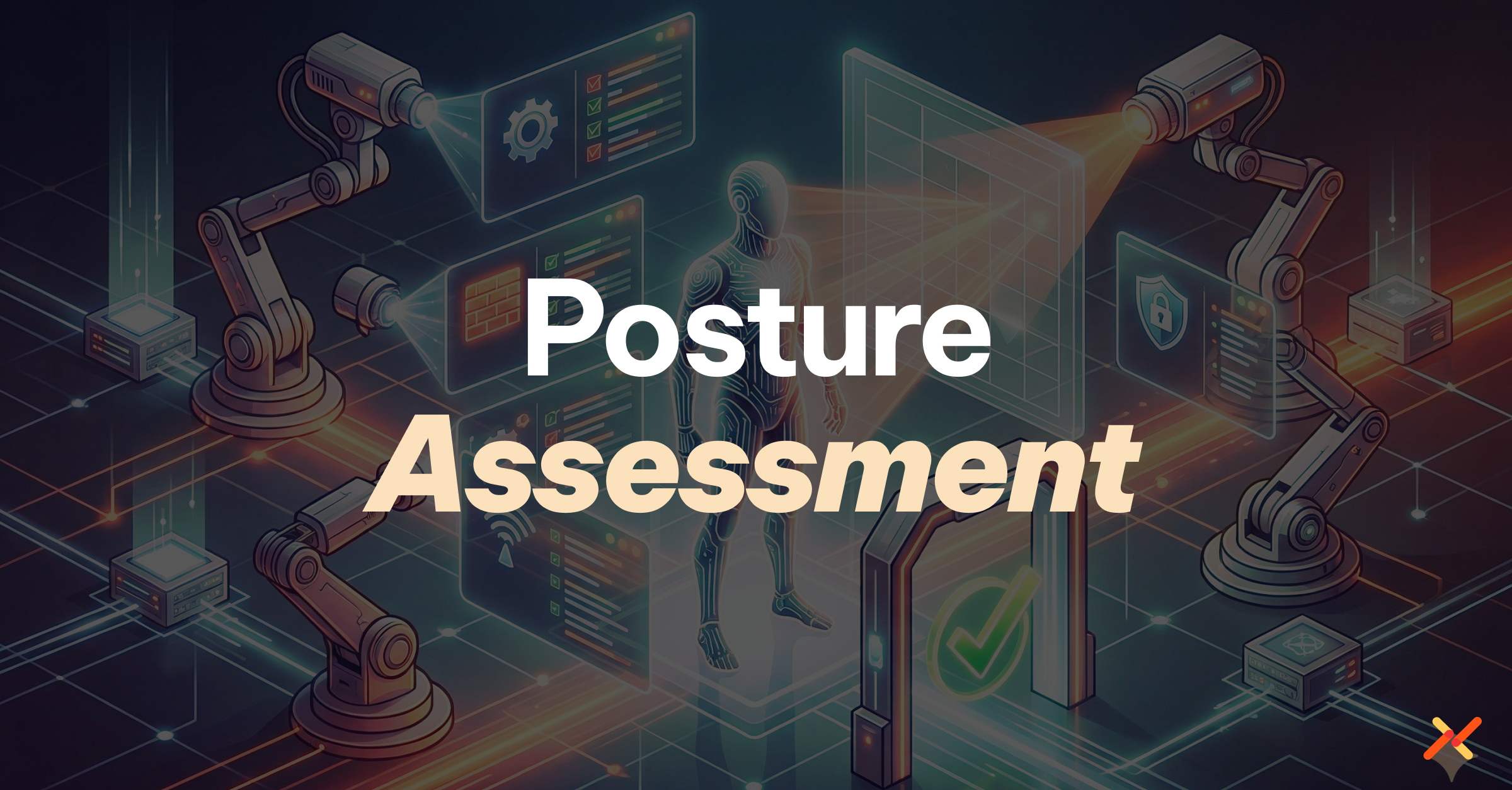
Posture assessment is the continuous evaluation of an organization’s security status based on its defensive capabilities, configurations, and readiness to respond to threats. In workload identity and access management, it serves as the foundational mechanism for dynamic, context-aware access decisions based on real-time security state.
How It Works
Posture assessment operates through continuous monitoring and multilayered evaluation. According to NIST SP 800-137, Information Security Continuous Monitoring (ISCM) maintains ongoing awareness of security vulnerabilities and threats to support real-time risk management decisions.
In modern cloud environments, this assessment examines multiple dimensions simultaneously: infrastructure security (host configurations, network segmentation, encryption posture), workload integrity (container image vulnerabilities, runtime configurations, deployment contexts), and application security (API authentication mechanisms, service account hygiene, authorization controls).
The technical implementation typically involves a policy enforcement architecture where a Policy Enforcement Point queries posture data before granting access, while a Policy Decision Point aggregates signals from multiple sources, including endpoint detection and response platforms, cloud security posture management tools, and workload protection platforms. When a workload requests access to a resource, the system evaluates attributes such as patch status, vulnerability scan results, compliance with security policies, and behavioral anomalies before issuing credentials or granting permissions.
For workload identity systems, posture assessment complements identity issuance. Platforms like SPIFFE/SPIRE perform attestation to validate workload identity before issuing credentials, while posture assessment separately evaluates whether the workload’s environment meets security requirements. Together, they enable posture-based access control at the identity layer: even a workload with a valid identity can be denied credentials if its security posture falls short.
Why This Matters for Modern Enterprises
Zero-trust architecture fundamentally depends on posture assessment. NIST SP 800-207 explicitly states that in zero trust, access to resources is determined by a dynamic policy that includes “the observable state of client identity, application/service, and the requesting asset.” Without continuous posture evaluation, zero-trust principles collapse back to perimeter-based trust models.
For enterprises deploying AI agents and hybrid workloads, posture assessment enables secure automation at scale. When an AI agent running in a containerized environment requests access to sensitive customer data, the system can verify that the container hasn’t been compromised, the host OS is patched, the EDR agent is active, and the workload meets compliance requirements before granting temporary credentials. This dynamic evaluation reduces the blast radius of potential breaches while enabling the speed and flexibility that modern DevOps teams require.
Cloud-native architectures amplify the need for automated posture assessment. In environments where workloads scale dynamically across multiple clouds, manual security validation becomes impossible. Enterprises require systems that automatically assess security posture as workloads spin up, continuously monitor them during operation, and immediately revoke access when posture degrades.
Common Challenges With Posture Assessment
Identity-mapping complexity represents a critical challenge in federated environments. When workload identities span multiple clouds and identity providers, correctly mapping posture attributes to the right identity often fails. Organizations struggle when external identity claims don’t align cleanly with internal principals, leading to either overly permissive policies (to avoid breaking workflows) or overly restrictive ones (causing operational friction). Subject collisions occur when two identities from different sources map to the same principal, creating security gaps and audit trail confusion.
Tool sprawl creates integration nightmares. A typical enterprise might deploy separate solutions for cloud security posture management, container security, endpoint detection, vulnerability scanning, and compliance checking. Each tool generates posture data in different formats, with different APIs, and different refresh rates. Security teams spend significant effort building custom integration layers to aggregate this data into unified access policies.
Performance impacts can undermine adoption. Real-time posture checks add latency to every access request. When a CI/CD pipeline queries an API that requires posture validation from three different security tools, those milliseconds accumulate. Organizations face difficult tradeoffs between security thoroughness and developer experience.
Policy management at scale becomes unwieldy quickly. As environments grow to thousands of workloads across multiple clouds, maintaining consistent posture requirements while accommodating legitimate exceptions requires sophisticated policy engines. Teams often resort to overly broad policies because managing granular, context-specific rules becomes operationally unsustainable.
How Aembit Helps
Aembit enforces zero-trust principles for workload access by evaluating the workload security posture in real time and granting access only when posture-based security conditions are met. The platform integrates with CrowdStrike Falcon for endpoint security posture and Wiz for cloud security posture, enabling access decisions based on live security signals rather than static credentials. These integrations allow Aembit to incorporate security posture data into conditional access policies, where access is granted only when specified posture conditions are satisfied.
Through Aembit’s conditional access framework, organizations define if-then rules that incorporate security posture as contextual signals. For example, a workload can access a production database only when its host passes CrowdStrike posture checks, runs in an approved region, and operates during authorized time windows. The Aembit Edge component handles credential injection and policy enforcement without requiring code changes, while the centralized control plane provides unified policy management across hybrid environments.
This architecture maintains clear associations between workload identities, their posture providers, and access policies in a unified control plane. Through integration with security posture providers like CrowdStrike and Wiz, conditional access policies can incorporate real-time security posture data, enabling access decisions to be based on current security state and enabling dynamic policy enforcement when security posture changes.
FAQ
You Have Questions?
We Have Answers.
How does posture assessment differ from vulnerability scanning?
Vulnerability scanning is a tactical process that identifies known CVEs in systems and applications through point-in-time checks. Posture assessment is a strategic, holistic evaluation that encompasses vulnerability data but also includes configuration compliance, policy adherence, behavioral analytics, and organizational readiness. According to NIST SP 800-115, posture assessment evaluates people, processes, technology, and policies to determine overall defensive capabilities, while vulnerability scanning focuses specifically on technical weaknesses in software and systems.
What posture attributes are most critical for workload access decisions?
The most impactful attributes span infrastructure and runtime layers. Infrastructure attributes include host patch status, EDR agent health, network segmentation compliance, and encryption posture. Runtime attributes cover container image vulnerabilities, privilege escalation settings, resource limit compliance, and behavioral anomalies. For cloud workloads, authentication mechanism strength (certificate validity, token expiration, key rotation compliance) and authorization scope (RBAC configuration, excessive permissions) often determine whether an access request represents acceptable risk.
Can posture assessment work at cloud-native speed and scale?
Yes, through integration of continuous monitoring with policy-based access control. According to NIST SP 800-137, continuous monitoring maintains ongoing awareness of security vulnerabilities and threats to support organizational risk management decisions in real time. In modern implementations, this works through policy enforcement architectures where Policy Enforcement Points query posture data before granting access, while Policy Decision Points aggregate signals from multiple sources, including endpoint detection platforms, cloud security posture management tools, and workload protection platforms. For workload identity systems, platforms like SPIFFE/SPIRE integrate posture validation directly into identity issuance, performing attestation to validate workload identity and integrity before issuing credentials. This architecture allows organizations to scale security validation across dynamic cloud environments where workloads spin up and down rapidly, automatically assessing posture as part of the access decision process without requiring manual intervention for each workload.
How does posture assessment integrate with workload identity systems?
Posture assessment integrates directly into workload identity issuance and validation. In systems like SPIFFE/SPIRE, attestation validates both workload identity and integrity before issuing credentials. If attestation fails because the workload doesn’t meet minimum security requirements, such as running an outdated container image or operating on a compromised host, the system denies the identity credential. This implements posture-based access control at the identity layer rather than as a separate authorization step. For access decisions, Policy Enforcement Points query posture data from multiple sources (endpoint detection platforms, cloud security posture management tools, vulnerability scanners) and Policy Decision Points evaluate this against defined policies before granting access to resources. This architecture ensures that security posture directly influences both identity issuance and resource access, enabling the continuous verification model required by zero-trust architectures.