

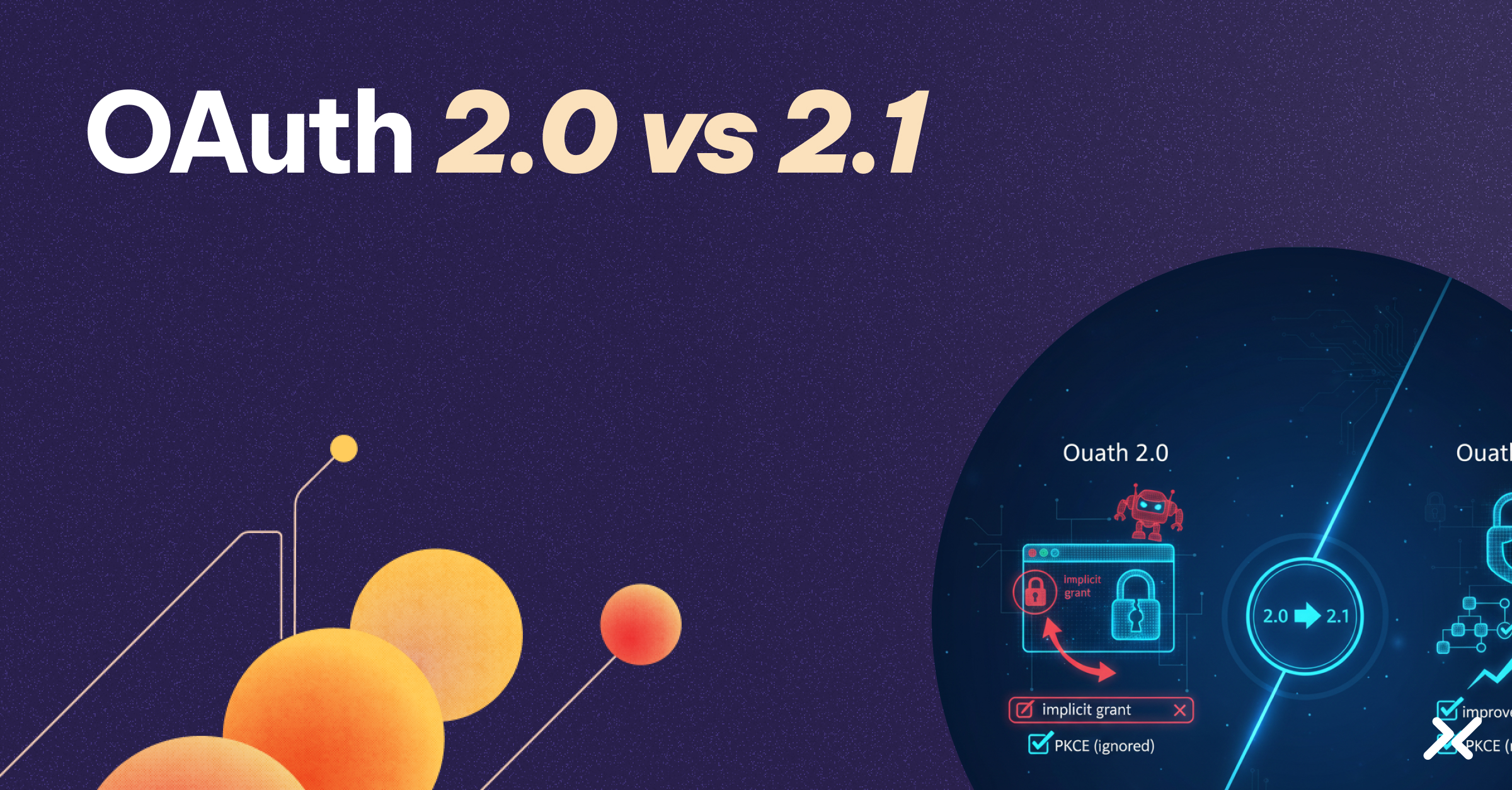
OAuth 2.1 exists because OAuth 2.0 gave developers too much rope. Implicit grants leaked tokens in browser URLs, PKCE was optional, and applications routinely collected user passwords directly. A decade of security RFCs patched these patterns one at a time, but the fixes were scattered across separate specs that teams adopted inconsistently.
OAuth 2.1 consolidates those fixes into a single specification. It rolls in PKCE (RFC 7636), the browser-based apps guidance, and RFC 9700 (OAuth 2.0 Security Best Current Practice, published January 2025), while dropping the flows that were consistently misused. The spec is in late-stage IETF draft (draft-ietf-oauth-v2-1-15) and hasn’t been published as a final RFC yet, but the technical requirements are stable and widely adopted by major authorization servers.
If you’re still running implicit grants or optional PKCE, your applications are exposed to attack vectors that OAuth 2.1 specifically closes. The changes aren’t incremental improvements. They’re hard requirements that break backward compatibility in several places.
The sections below cover what changed in OAuth 2.0 vs 2.1, a practical migration plan, and where OAuth 2.1’s scope ends, particularly for service-to-service communication, where static credentials remain an open problem.
What OAuth 2.1 Removed: Implicit Flow, Password Credentials, and Tokens in URLs
The shift from OAuth 2.0 to 2.1 eliminates three flows that created attack vectors developers consistently implemented incorrectly.
| Flow | OAuth 2.0 Status | OAuth 2.1 Status | Why It Was Removed |
| Implicit Grant | Recommended for SPAs | ❌ Eliminated | Tokens exposed in URLs |
| Password Credentials | Permitted | ❌ Eliminated | Violates delegated authorization |
| Tokens in Query Params | Allowed | ❌ Prohibited | Leak through logs and caches |
Implicit Flow Is Gone
OAuth 2.1 removes the implicit flow entirely. Now, the authorization code flow with PKCE serves all client types. Confidential servers, single-page applications (SPAs), and mobile apps all use the same secure pattern, with no exceptions.
Migrate your SPAs from the implicit grant to the authorization code flow immediately.
Resource Owner Password Credentials Flow Is Deprecated
OAuth 2.1 removes this flow from the specification. For user authentication, use the authorization code flow. For service accounts, use the client credentials flow. Applications have no legitimate reason to collect user passwords directly anymore.
Bearer Tokens Must Stay Out of URLs
OAuth 2.1 prohibits tokens in query strings. Access tokens belong exclusively in Authorization headers or POST request bodies.
Audit your API calls to confirm that tokens are never transmitted through URL parameters.
OAuth 2.1 Security Requirements: PKCE, Exact Redirect Matching, and Token Rotation
OAuth 2.0 documented security best practices as optional recommendations. OAuth 2.1 makes these practices mandatory requirements.
PKCE Is Required for All Clients
Proof Key for Code Exchange (PKCE) prevents authorization code interception attacks. Here’s how it works: the client generates a cryptographically random code verifier (at least 43 characters), hashes it to create a code challenge, and sends the challenge with the initial authorization request.
When the client later exchanges the code for tokens, it proves possession by presenting the original verifier, and the authorization server validates the match.
In OAuth 2.0, PKCE was optional and only recommended for public clients. OAuth 2.1 makes it mandatory for all client types.
Implement PKCE using cryptographically secure random generation for your code verifiers to ensure sufficient entropy.
Redirect URI Must Match Exactly
In OAuth 2.0, authorization servers often allowed flexible redirect URI matching; things like wildcard patterns or subdomain matching. That flexibility enabled open redirect vulnerabilities where attackers could trick the system into sending authorization codes to domains they controlled.
OAuth 2.1 requires exact string matching for redirect URIs, which means no wildcards, no partial matches, and no flexible patterns. Register every valid redirect URI explicitly in your authorization server configuration.
This requirement affects developers running multiple environments. Use separate OAuth client configurations for development, staging, and production rather than attempting to share client credentials across environments. Register URIs for each environment individually.
Implement Refresh Token Rotation
Refresh tokens in OAuth 2.0 could remain valid indefinitely. A stolen refresh token provided persistent access until manual revocation occurred. These long-lived tokens created a huge window for attackers.
OAuth 2.1 requires that refresh tokens for public clients be either sender-constrained or one-time use, which in practice means most implementations adopt rotation. With rotation, every time you use a refresh token, the server issues a new one and invalidates the old one. This limits the damage from token theft: a stolen refresh token works exactly once before it’s useless.
Implement rotation carefully to avoid breaking user sessions. Make sure your authorization server handles refresh requests atomically: it must issue the new token before invalidating the old one to prevent race conditions.
Other improvements in OAuth 2.1 include standardized authorization server metadata through discovery endpoints and consistent error response formats.
Pro tip: Use those discovery endpoints instead of hardcoding your authorization server URLs. This eliminates configuration errors when the servers change endpoints.
How to Migrate from OAuth 2.0 to 2.1: Assessment, Priority, and Deployment
OAuth 2.1 migration follows a risk-based priority model: eliminate critical vulnerabilities first, then implement remaining requirements.
Inventory Your OAuth Flows First
Start migration by documenting current OAuth usage across your organization. Identify which flows each application uses: implicit, authorization code, client credentials, or password credentials.
Document all redirect URI configurations in your authorization server. Determine where tokens are transmitted, whether headers, query parameters, or POST bodies. Verify your authorization server’s OAuth 2.1 support status.
This inventory reveals migration scope and identifies high-risk patterns requiring immediate attention.
Your 6-Week Migration Checklist
Week 1 (critical):
- Eliminate implicit flow in all SPAs
- Remove tokens from query parameters
Weeks 2-3 (high priority):
- Add PKCE to authorization code flows
- Enforce exact redirect URI matching
Weeks 4-6 (medium priority):
- Implement refresh token rotation
- Migrate to discovery endpoints
Week 1 eliminates the most severe token exposure risks. Weeks 2-3 prevent authorization code interception and open redirect attacks. Weeks 4-6 limit the damage from token theft and reduce configuration errors.
Avoid These Migration Pitfalls
Four common mistakes often break OAuth 2.1 migrations. Watch out for these:
- Coordination failures: Notify all application teams before modifying redirect URI configurations. The exact matching requirements will break applications that are expecting flexible patterns.
- Weak PKCE implementations: Generate code verifiers using cryptographically secure random number generators. Never use predictable values or insufficient entropy.
- Incomplete cleanup: After eliminating implicit flow, audit client-side code for localStorage references where applications stored tokens. These references can cause errors or expose tokens unnecessarily.
- Insufficient testing: Test authorization failures explicitly. Verify token expiration handling. Confirm refresh scenarios work correctly. Authentication edge cases cause user-facing failures when overlooked.
Test, Monitor, and Roll Out Gradually
Deploy changes to development environments first. Use feature flags to enable gradual rollout to production traffic. Monitor authentication failure rates during transition periods. Spikes indicate breaking changes affecting users. Maintain rollback capability for critical issues discovered during deployment.
OAuth 2.1 for Users vs. Workloads: Where the Standard Ends
OAuth 2.1 secures user authentication effectively, but it doesn’t address the workload identity challenge.
Use OAuth 2.1 for User Authentication
Authorization code flow with PKCE is now your go-to for all user-facing applications. OAuth 2.1 provides strong, well-defined security for human users accessing applications through browsers or mobile apps.
Add OpenID Connect (built on OAuth 2.1 and compatible with OAuth 2.1 flows) when applications need user identity information beyond authorization.
Machine-to-Machine: OAuth’s Static Credential Gap
Client credentials flow remains valid for service accounts and workloads in OAuth 2.1. Applications present a client ID and client secret to obtain access tokens for API calls. This works for basic authentication, but it introduces security and operational challenges.
The gap is in the credential lifecycle. Client credentials are static secrets that must be pre-provisioned and stored. A compromised client secret provides ongoing access until someone manually rotates it, creating a persistent attack vector identical to the long-lived tokens that OAuth 2.1 works so hard to eliminate for users.
The problem compounds with ephemeral workloads. OAuth 2.1 improves authorization decisions but doesn’t address identity verification for containers, serverless functions, and CI/CD jobs that spin up and down constantly. These workloads need authentication without storing long-lived secrets.
Modern cloud-native architectures solve this through environment-based attestation that validates workload identity based on where it’s running, not on stored secrets. This approach eliminates static credentials entirely by verifying workload identity through cryptographic proofs from the runtime environment. Aembit takes this approach, replacing client credentials with secretless access for workload-to-workload communication.
Why Adopt OAuth 2.1 Now
OAuth 2.1 eliminates vulnerability classes that attackers actively exploit in OAuth 2.0 implementations. The mandatory security defaults (PKCE, exact redirect matching, removed implicit flow) prevent the implementation mistakes that created most of those vulnerabilities. Most organizations should complete migration within three to six months, prioritizing implicit flow elimination in the first week.
For workloads, the story is different. OAuth 2.1 secures user authentication effectively, but machine-to-machine communication still relies on static client credentials with the same lifecycle risks the spec was designed to address for users. Organizations migrating to OAuth 2.1 should evaluate workload identity solutions in parallel.
As you tighten user authentication, address workload identity with the same rigor. Aembit eliminates static credentials for service-to-service communication across cloud and SaaS environments. Try Aembit free for up to 10 workloads.