

Service accounts have quietly become the most common type of nonhuman identity in enterprise infrastructure. Every CI/CD pipeline, microservice and SaaS integration needs one, and in many organizations they now outnumber human users by an order of magnitude. CyberArk’s 2025 Identity Security Landscape found 82 machine identities for every human, with 42 percent carrying privileged access.
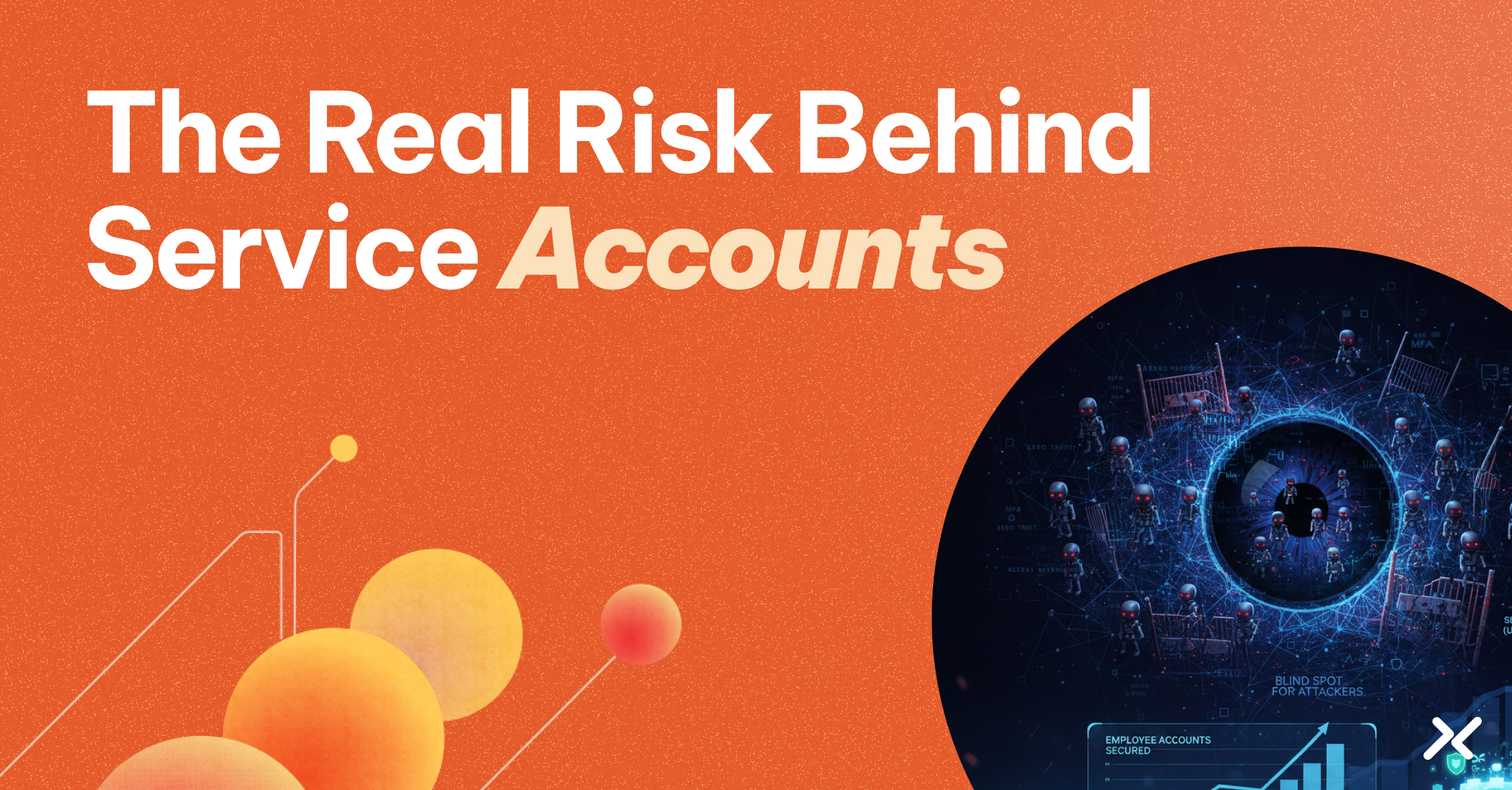
Yet while companies pour resources into securing employee accounts with MFA, zero trust and regular access reviews, service accounts still get created with static credentials, granted sweeping permissions and then left unmanaged. This creates a growing population of identities that operate outside traditional IAM controls. To secure modern automation, enterprises need to understand how these identities escape visibility and what strategies can bring them under governance.
Why Service Accounts Escape Governance
The rise of cloud and DevOps created an identity crisis. Every new microservice and automation script needs an identity to talk to databases and other services. The old onboarding model, with managers approving access and regular reviews, was built for people. Service accounts don’t have a manager to sign off on a request. Developers, under pressure to ship, create these identities on the fly, provision them automatically and replicate them across environments without a centralized system to track them.
The typical pattern looks like this: a developer needs a service to read from a database, so they create a service account, grant it database access, test the connection and move on. Six months later, that service account is still active with the same permissions, and the developer who created it has moved to a different team. Nobody remembers why the account exists, nobody reviews its permissions and nobody has a process to decommission it when the service is retired. Multiply this across hundreds of services and you can see how the inventory spirals.
The visibility problem compounds across environments. Each cloud defines and trusts identities differently. AWS uses IAM roles and STS tokens, Azure relies on service principals and managed identities and GCP uses service accounts that authenticate with either legacy JSON keys or modern federated tokens. Each operates within its own trust domain with no shared root of trust. Your development teams add another layer: GitHub Actions, Jenkins and GitLab each maintain their own siloed credential stores. Credentials get created on the fly to unblock a developer’s workflow, often without the security team knowing they exist. And every SaaS tool from Salesforce to Stripe has its own way of handling API keys and integrations, with identities that live outside your corporate network entirely.
This fragmentation means no single team has a complete picture of which service accounts exist, what they can access or who owns them. Silverfort’s research found that 40 percent of cloud NHIs lack an assigned owner, and only 5.7 percent of organizations in Osterman Research’s 2023 study could accurately inventory all their service accounts.
How Attackers Exploit Over-Privileged Service Accounts
The privilege problem starts with good intentions. When a service account needs access to a resource, the quickest path is broad permissions. A developer gives a new service account admin access for a prototype, that same access goes into production and six months later another developer copies that overly permissive policy as a template for a new service. The gap between what a service account can do and what it actually needs to do widens with every copy. Without automated entitlement review, you have no way to know if a service account’s permissions are frozen in time, far beyond their original purpose.
Once an attacker compromises a single over-privileged service account, the damage compounds quickly. Service account credentials are often hardcoded in application code and checked into version control, baked into container images or stored as long-lived tokens in CI/CD pipelines. GitGuardian’s 2026 report found roughly 29 million secrets detected on public GitHub in 2025. Unlike human accounts protected by MFA and lockout policies, service accounts use static tokens with no extra verification step. A stolen credential works regardless of where, when or how it’s used.
With a single compromised credential, an attacker can move laterally across your infrastructure. An over-permissioned IAM role can grant administrative access. A Kubernetes ServiceAccount with excessive privileges gives unrestricted access to your cluster. These accounts become persistent backdoors that outlive their original purpose. The NSA-CISA Joint Advisory AA23-278A directs organizations to elevate privileges only as necessary, but with only 1 percent of organizations at full JIT adoption according to CyberArk, the gap between guidance and practice remains wide.
Traditional detection tools struggle with service account behavior. A single service account might make thousands of API calls per hour, authenticate from multiple IP addresses at once and work around the clock. This behavior would trigger immediate alerts for a human user, but it’s normal for a microservice. SIEM and UEBA systems tuned for human patterns generate constant noise from legitimate automation, and security teams learn to ignore the alerts. CyberArk’s research found that 54 percent of organizations uncover unmanaged privileged accounts and secrets weekly. That weekly accumulation means unmonitored risk is compounding faster than most teams realize.
The problem is growing. AI agents are adding a new category of service identities that behave even less predictably than traditional microservices. An AI agent might chain API calls across multiple providers in a single workflow, access different resources depending on the task it’s been assigned and operate on behalf of a human user. These patterns make behavioral baselines even harder to establish.
Shared credentials compound the detection challenge further. If three microservices share the same API key, a suspicious request could have originated from any of them. A single compromised key can affect every service that uses it, and revoking it means finding every location where it was injected. By the time an analyst investigates, the ephemeral resource that made the call may have already been terminated. Without a baseline of normal behavior for each identity, anomaly detection either drowns in false positives or misses genuine compromises.
Bringing Service Accounts Under Governance
Securing these identities requires moving beyond the manual controls designed for human users. The OWASP NHI Top 10 ranks improper offboarding (NHI1), overprivileged NHIs (NHI5) and long-lived secrets (NHI7) among its most critical risks, and all three apply directly to service accounts.
| Strategy | OWASP Risk | What Changes |
|---|---|---|
| Protect known-critical resources first | NHI1: Improper Offboarding | Assign owners, dedicated identities, automated decommissioning |
| Replace static credentials with identity-based access | NHI7: Long-Lived Secrets | Workload identity federation, short-lived tokens, no stored keys |
| Enforce policy centrally and monitor anomalies | NHI5: Overprivileged NHI | Context-aware access, posture checks, per-workload baselines |
Protect what you already know is sensitive. You already know where your most critical data sources and workloads are. Secure those first with dedicated identities, short-lived credentials and least-privilege policies. Then expand outward with automated discovery scanning across your AWS, Azure, GCP, Kubernetes clusters, CI/CD systems and SaaS integrations so shadow identities get caught before they become permanent fixtures. Assign an owner to every service account. Without ownership mapping, offboarding doesn’t happen for machine identities, which is exactly the risk OWASP NHI1 targets.
Replace static credentials with identity-based access. Instead of distributing long-lived keys, verify a service’s identity at runtime and grant temporary access only when needed. A CI/CD job can receive cloud credentials that expire as soon as the deployment finishes. Workload identity federation eliminates the need to store secrets in pipeline configurations or environment variables. CISA’s SCuBA Hybrid Identity Guidance prohibits hardcoded credentials in code or configuration files. This approach removes persistent backdoors and shrinks the blast radius if an identity is ever compromised.
Enforce policy centrally and monitor for real anomalies. With policy-based access, you can define exactly what resources a workload can access based on its verified identity, then enforce that policy consistently across environments. Conditional access can incorporate posture checks from tools like CrowdStrike or Wiz, so a workload that fails a vulnerability scan loses access regardless of whether its identity token is valid. For monitoring, the goal is a system that learns what normal looks like for each workload and flags only genuine deviations, not every API call a microservice makes at 3 a.m.
From Blind Spot to Governed Identity
Most organizations still treat service accounts as a side problem while their largest and most privileged identity population operates with minimal oversight. The OWASP NHI Top 10 exists because the industry recognized this gap. Breach after breach confirms it, from Snowflake to Okta to Salesloft/Drift. Moving forward means abandoning human IAM patterns for identities that don’t behave like humans.
That means automated governance, identity-based access and security controls built for the scale and speed of machine identities. Your service accounts need the same rigor you apply to employee accounts: verified identity, scoped permissions, credentials that expire and continuous monitoring. The difference is that automation must handle what managers and HR workflows handle for humans.
Aembit’s workload IAM platform verifies workload identity and brokers short-lived, identity-bound access, so your service accounts authenticate without static credentials and your security team gets centralized, auditable control across every environment.