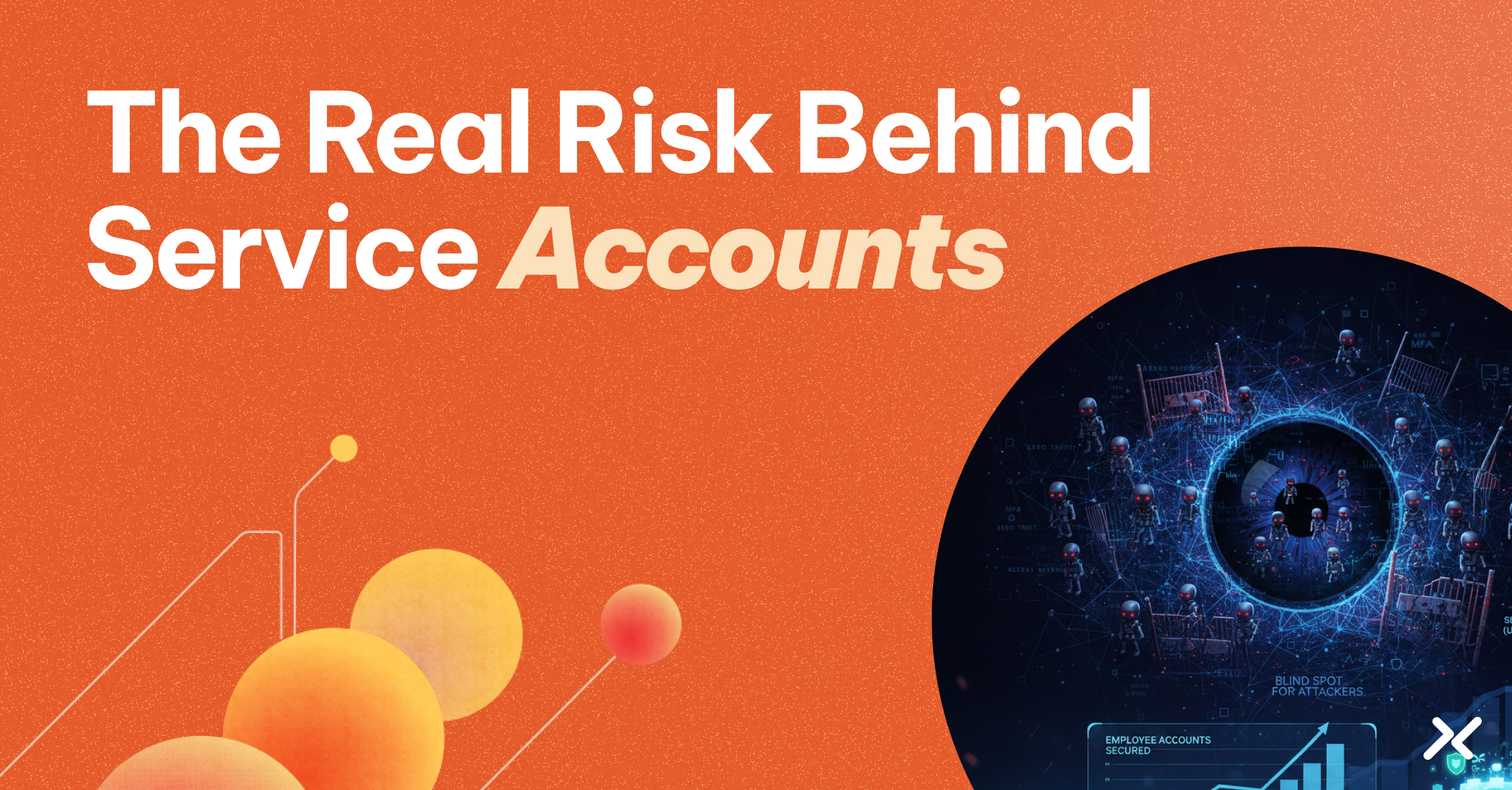


79 percent of cyberattacks now rely purely on identity compromise, using legitimate credentials to move laterally, escalate privileges and exfiltrate data while appearing authorized at every step.
Service accounts represent the automated backbone of modern infrastructure, operating continuously across cloud platforms, databases, APIs and container orchestrators as non-human identities.
Their ubiquity makes them indispensable, but their security weaknesses make them the most attractive target in enterprise environments.
What Are Service Accounts and Why Do They Exist?
Service accounts are programmatic identities that enable software systems to authenticate and access resources without human intervention. According to NIST SP 800-63-4, these credentials are fundamentally distinct from user accounts because they’re tied to software entities rather than natural persons.
A Kubernetes pod authenticating to AWS, a GitHub Actions workflow deploying code, or a monitoring agent querying databases all rely on service accounts to prove their identity and obtain authorization.
Service accounts represent a category of non-human identities, but implementation methods vary significantly. Organizations can choose between static credentials (API keys, passwords) or modern workload identity solutions that eliminate stored credentials through cryptographic environment verification.
Cloud providers offer managed identities that handle credential lifecycle automatically. The primary risk stems from static credentials that service accounts use, such as tokens or hardcoded secrets that persist over time.
Modern microservices architectures multiply these identities exponentially. A typical Kubernetes application requires service accounts for pod authentication, cloud storage access, database connections and CI/CD deployment across environments like AWS IAM, Azure service principals, Google Cloud and Active Directory.
The proliferation creates immediate challenges. Service accounts lack the natural lifecycle management that human accounts inherit from HR systems.
When an engineer creates a service account to fix a production issue, no process ensures that account gets documented, assigned an owner, or deactivated when the temporary need ends. These “zombie accounts” accumulate over years, often outliving the employees who created them.
Compounding this, existing service accounts often get reused by different teams, repurposed for other applications, or shared across development, staging, and production environments. This ad-hoc reuse makes it nearly impossible to track what a service account actually does, who depends on it, or what breaks when someone finally tries to disable it.
The credential types compound complexity. Service accounts authenticate through API keys stored in configuration files, long-lived access tokens embedded in code, X.509 certificates protecting microservice-to-microservice communication, OAuth 2.0 client credentials for API access and SSH keys enabling automated deployments.
This determines whether your infrastructure operates as designed or provides attackers with persistent, privileged access that evades every traditional security control.
Five Critical Security Vulnerabilities
Service accounts represent a systemic security gap because they operate outside the identity governance frameworks designed for humans. According to NIST SP 800-63-4, this structural separation creates gaps in visibility that modern “identity-first” architectures must remediate.
The following five critical vulnerabilities represent the primary vectors for machine identity compromise.
1. Excessive Privileges and Privilege Creep
Service accounts routinely accumulate permissions that exceed their operational needs, often due to “broad provisioning” during development cycles to avoid troubleshooting granular blocks.
- The Vulnerability: BeyondTrust analysis reveals that 46.4% of Google Cloud security alerts in late 2024 stemmed from over-privileged service accounts.
- Forensic Evidence: The 2020 SolarWinds breach demonstrated this at scale. Attackers hijacked the Orion service account, which possessed years of “accumulated permissions.” This allowed the adversary to inherit high-level administrative rights across 18,000 organizations, making malicious lateral movement appear as authorized administrative activity.
2. Credential Exposure and Hardcoded Secrets
Machine identities require secrets to authenticate, but these secrets are frequently stored in insecure, static formats.
- The Vulnerability: GitGuardian research highlights the prevalence of credentials hardcoded in source code, CI/CD pipelines, and container images.
- Forensic Evidence: In the 2022 Uber breach, CyberArk’s postmortem revealed that attackers found PowerShell scripts containing hardcoded privileged credentials on a misconfigured network share. This allowed the attacker to escalate from a basic entry point to full Domain Administrator privileges.
3. Monitoring Gaps and Programmatic Anomaly Detection
Because service accounts lack human interaction, they cannot use traditional Multi-Factor Authentication (MFA), and their programmatic behavior is often ignored by standard audit logs.
- The Vulnerability: Traditional security tools struggle to distinguish between a high-volume legitimate process and a malicious data exfiltration event. CISA Advisory AA25-212A identifies this lack of “Workload MFA” (cryptographic attestation) as a critical cyber hygiene gap.
- Forensic Evidence: The BRICKSTORM backdoor campaign (CISA AR25-338A) exploited this exact gap. By harvesting service account credentials from Windows domain controllers, attackers established persistent access across virtualization infrastructure. Detection occurred only through manual threat hunting, as automated alerts failed to flag the “legitimate” service account logins.
4. Lateral Movement via Legacy and Hybrid Authentication
Service accounts often rely on legacy protocols (NTLM, Kerberos) that are susceptible to specialized identity attacks.
- The Vulnerability: Techniques such as Kerberoasting (extracting hashes from Kerberos tickets) and Pass-the-Hash allow attackers to authenticate without ever knowing the plaintext password.
- Forensic Evidence: The BadSuccessor attack vector (documented by Palo Alto Networks Unit 42) shows attackers abusing Managed Service Accounts to escalate from low-privilege access to domain admin equivalents. This research proves that attackers can pivot from compromised on-premises service accounts to cloud environments by exploiting these legacy trust relationships.
5. Supply Chain and Persistent Nation-State Exploitation
State-sponsored actors target service accounts specifically because they offer long-term “dwell time” without the risk of a password reset or MFA prompt.
- The Vulnerability: “Living off the land” tactics involve using legitimate, stolen service account credentials to move through a network, effectively blending in with background noise.
- Forensic Evidence: CISA Advisory AA24-038A documented the PRC-sponsored Volt Typhoon actors using this methodology to maintain persistence in U.S. critical infrastructure. Similarly, the 2024 GeoServer vulnerability (CVE-2024-36401) allowed attackers to pivot immediately to service account theft, providing extended dwell time within federal systems that was nearly impossible to baseline.
Closing the Gap: Zero Trust and Workload Identity
Organizations can implement workload identity through cloud-native solutions (AWS IAM Roles Anywhere, Azure Workload Identity Federation, GCP Workload Identity Federation), open-source frameworks (SPIFFE/SPIRE), or commercial platforms (including solutions like Aembit).
These approaches share common principles: eliminating long-lived credential storage by issuing short-lived credentials that expire automatically within hours to days.
The architectural shift from long-lived credentials to workload identity solutions represents the single highest-impact improvement available.
AWS IAM Roles Anywhere uses X.509 certificates to obtain temporary credentials, Azure Workload Identity Federation allows external identity tokens to exchange for Azure AD tokens without storing secrets and GCP Workload Identity Federation enables service accounts to impersonate external identities using short-lived tokens.
Organizations should prioritize discovery before implementing controls. You cannot secure service accounts you don’t know exist.
The Uber breach demonstrated this failure: attackers discovered PowerShell scripts with hardcoded privileged credentials that the organization had never inventoried.
Automated discovery tools should scan cloud IAM, Active Directory, code repositories and container registries with policy enforcement preventing new service accounts without documented owners.
Zero trust architecture requires rethinking service account authentication entirely. Modern implementations verify every request explicitly, enforce least privilege access dynamically and assume breach at all times.
The convergence between government guidance, cloud provider implementations and breach evidence points to clear implementation priorities supported by authoritative sources.
Zero trust architecture requires rethinking service account authentication entirely. Modern implementations verify every request explicitly, enforce least privilege access dynamically and assume breach at all times.
For workloads, this means extending the same conditional access controls that protect human users: evaluating posture, location and compliance status before granting access. Solutions like Aembit take this further with credential injection, where secrets are delivered directly to workloads at runtime without ever passing through developer hands or landing in code repositories. This secretless approach eliminates the leak vector at its source while simplifying development, as engineers can stop writing authentication logic and start focusing on features.
The convergence between government guidance, cloud provider implementations and breach evidence points to clear implementation priorities.
Your Immediate Priority For 2026 And Beyond
The CISA Zero Trust Maturity Model v2 and NSA/CISA IAM Best Practices mandate organizations immediately implement workload identity solutions as the highest-impact security control.
Cloud providers offer production-ready solutions that eliminate credential rotation debates entirely by expiring credentials within hours to days.
- Deploy zero-trust verification for every service account authentication attempt. CISA Zero Trust guidance establishes three principles: verify explicitly for every transaction, use least privilege access and assume breach.
- Establish just-in-time (JIT) privileged access with automated workflows that provision and revoke credentials per task. Credential injection ensures these short-lived credentials reach workloads at runtime without touching application code or developer workflows. CyberArk’s PAM Modernization 2025 guidance shows modern PAM solutions integrate JIT with policy engines that evaluate context before issuing temporary credentials with defined time-to-live periods and automatic revocation.
- Integrate service account monitoring into SIEM systems with behavioral baselines that flag anomalies, as required by NIST SP 800-53 Rev 5 Controls AU-2, AU-3, AU-6 and AU-12 for audit generation, record structure, review procedures and audit trail capabilities. Configure alerts for authentication anomalies, privilege escalation attempts and lateral movement indicators.
The gap between current practice and these recommendations remains vast. Organizations with comprehensive service account inventories, credential rotation automation and workload identity implementations operate at advantage levels their competitors cannot match.
Those still relying on static API keys hardcoded in configuration files face significant breach risk. This rate will continue rising until organizations treat service account security as foundational rather than aspirational.