


An employee pastes a customer list into ChatGPT to draft a follow-up email. A coding assistant memorizes proprietary source code from its training data. An AI agent with database access returns thousands of records when it only needed one.
None of these require a malicious hacker or a security vulnerability – they’re just AI doing what AI does.
AI data leakage is the unintended exposure of sensitive information through the normal operation of AI systems, and it’s becoming one of the fastest-growing security risks in the enterprise.
This post breaks down the causes, maps where leakage happens across the AI stack, and walks through the controls that actually work – including why AI agent identity is becoming a critical part of securing access for AI agents.
AI data leakage is the unintended exposure, retention, or extraction of sensitive information through the use, training, or deployment of artificial intelligence systems.
Unlike a traditional data breach that requires someone to break into a network, AI data leakage often happens through normal system operation.
An employee pastes customer data into Claude. A model memorizes training data and reproduces it later. An agent queries a database and returns more records than it was supposed to.
What makes AI leakage different from other security risks? A few things stand out:
- Memorization: Large language models can store fragments of their training data and reproduce them when prompted in certain ways.
- Context retention: Data entered into prompts or conversation history may persist longer than users expect, sometimes across sessions.
- Third-party exposure: Information sent to external AI providers may be logged, stored, or used to improve future model versions.
The risk is growing fast. Shadow AI, where employees use unapproved AI tools, has become a common factor in enterprise data incidents. IBM’s 2025 Cost of a Data Breach Report found shadow AI adds $670,000 in additional breach costs on average. And because AI leakage doesn’t require a human-led exploit, it often flies under the radar until sensitive data has already left the building.
What Causes AI Data Leakage
The causes span the entire AI lifecycle. Some happen at the user level, others deep in infrastructure. Understanding each vector is the first step toward addressing them.
Sensitive Data in Prompts and Context Windows
The most common cause is also the simplest: users paste sensitive information directly into AI tools. A developer debugging code might include API keys. A sales rep might upload a customer contract. A support agent might copy an entire ticket thread containing personally identifiable information (PII).
Once that data enters the prompt, it may be logged by the provider, stored in conversation history, or used to train future models. Even if the provider promises not to train on your data, the information still travels outside your security perimeter.
Model Memorization and Training Data Extraction
LLMs don’t just process data. They can memorize it. Researchers have demonstrated extraction attacks where carefully constructed prompts cause models to reproduce up to 150× more verbatim training data than typical queries, including email addresses, phone numbers, and code snippets.
This risk applies both to public models trained on internet data and to enterprise models fine-tuned on internal documents. If sensitive data enters the training pipeline, it may resurface in unexpected outputs.
Overpermissioned AI Agents and Workloads
Autonomous agents represent a newer and more dangerous vector. When an agent is granted broad database or API access to “get the job done,” it often receives far more permissions than any single task requires.
Consider an agent designed to answer customer questions. If it has read access to the entire customer database rather than just the specific records relevant to each query, a single prompt injection or logic error could expose thousands of records. Long-lived credentials compound the problem: static API keys don’t expire, can be copied, and leave no trace of which agent used them.
Shadow AI and Unsanctioned Tool Use
Employees adopt AI tools faster than security teams can evaluate them—68% use free-tier AI tools via personal accounts, according to Menlo Security’s 2025 report. Someone uploads a spreadsheet to a free AI assistant. Another pastes source code into a coding helper. A third uses an unapproved transcription service for meeting recordings.
Each of these creates a data flow that bypasses corporate security controls entirely. Without visibility into which tools are in use, organizations can’t assess the leakage risk, let alone mitigate it.
Insecure MCP Servers and Agentic Tool Integrations
The Model Context Protocol (MCP) and similar frameworks let agents connect to databases, APIs, and internal tools. That’s powerful, but misconfigured MCP servers can expose sensitive resources to any agent that connects.
If an MCP server grants access based on a shared secret rather than verifying the specific agent’s identity and permissions, you’ve created a single point of failure. One compromised agent can access everything the server exposes.
Data Pipeline and Storage Misconfigurations
Sometimes the leak happens before the AI even runs. Training data stored in misconfigured S3 buckets or Azure Blob containers can be accessed by anyone who finds the URL. Vector databases used for retrieval-augmented generation (RAG) may lack proper access controls, allowing users to retrieve documents they shouldn’t see.
These infrastructure-level issues aren’t unique to AI, but AI systems amplify their impact by making the data queryable in natural language.
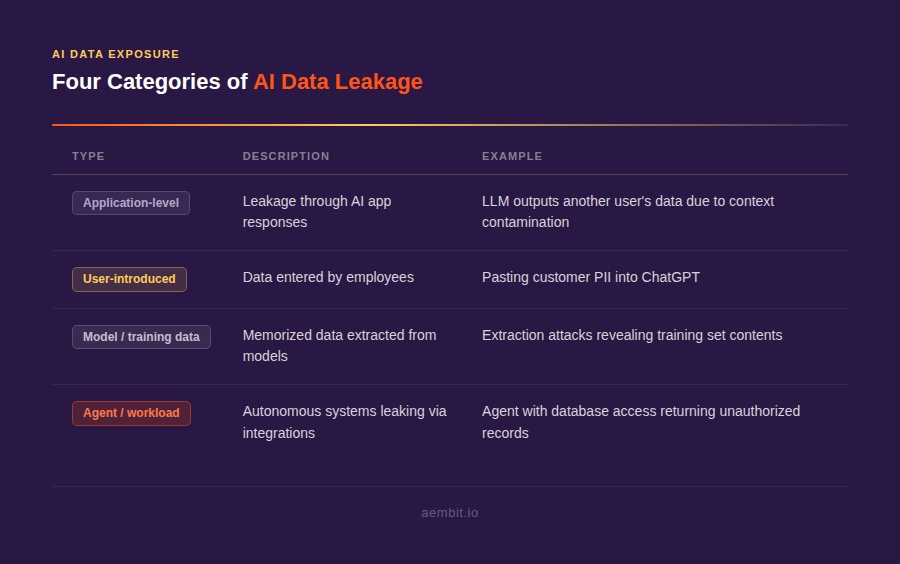
Where AI Systems Leak Data
Leakage can occur at multiple points across the AI stack. Mapping these helps identify where monitoring and controls are most critical.
- LLM responses to users: Cross-user contamination when conversation context bleeds between sessions.
- API responses and logs: Data returned to or stored by third-party AI providers.
- Agent tool calls: Direct queries to databases, SaaS applications, or internal systems that return more data than intended.
- Training pipelines: Data fed back into model improvement, potentially exposing it in future outputs.
Risks and Business Impact of AI Data Leakage
The consequences extend well beyond technical incidents. AI data leakage creates regulatory, financial, and reputational exposure that can persist long after the leak is contained.
Regulatory and Compliance Exposure
GDPR, HIPAA, PCI-DSS, CCPA, and similar regulations don’t distinguish between traditional breaches and AI-driven leakage. If PII or protected health information escapes through an AI system, the organization faces the same penalties and notification requirements.
Regulators are increasingly focused on AI data handling. The EU AI Act, enforceable August 2026 with fines up to €35 million, and emerging U.S. state laws add new obligations around transparency and data governance.
Intellectual Property and Trade Secret Loss
When proprietary code, product designs, or strategic plans enter external AI systems, they may be stored, logged, or used for training. Even if the provider doesn’t intentionally misuse the data, the information has left your control.
Trade secret protection often depends on demonstrating that reasonable measures were taken to keep information confidential. Allowing employees to paste secrets into public AI tools undermines that legal position.
Customer Trust and Reputational Damage
Customers expect their data to be protected. When an AI system exposes customer information, whether through a model output, an agent error, or a misconfigured integration, trust erodes quickly.
Expanded Attack Surface from Non-Human Identities
AI agents represent new identities with access to sensitive resources. Unlike human users, they operate at machine speed, don’t take breaks, and can be cloned or scaled instantly.
Without proper controls, each agent multiplies the attack surface. A single compromised agent credential can enable lateral movement across systems, data exfiltration, or unauthorized actions, all before a human notices anything unusual.
How to Detect AI Data Leakage
Detection requires visibility into both AI application behavior and the underlying data flows.
- Audit AI application logs: Look for sensitive data patterns in inputs and outputs.
- Monitor agent behavior: Track what resources agents access, when, and in what context.
- Detect anomalies: Flag unusual data flows, such as large data transfers to external endpoints or access outside normal business hours.
- Classify data: Identify sensitive data before it reaches AI systems.
How to Prevent AI Data Leakage
Prevention combines technical controls, policy enforcement, and architectural decisions. The following steps address the most common leakage vectors.
1) Inventory AI agents, Workloads, and Data Flows
You can’t secure what you don’t know exists. Start by mapping all AI tools, agents, and their data access paths. Include both sanctioned enterprise tools and shadow AI that employees may have adopted independently.
2) Implement Data Masking and Redaction
Remove or obscure sensitive data before it reaches AI systems. PII, credentials, and proprietary information can often be filtered at the point of entry using automated redaction tools.
3) Replace Long-Lived Secrets With Short-Lived Credentials
Static API keys and passwords persist indefinitely, can be copied, and leave no trace of which agent used them. Short-lived, just-in-time credentials limit the exposure window and make unauthorized use easier to detect.
This is where secretless authentication becomes valuable. Instead of distributing and rotating secrets, agents receive temporary credentials scoped to each specific task.
4) Apply Policy-Based Access Controls Per Agent
Not all agents require the same access. An agent answering customer questions doesn’t need write access to the billing system. An agent generating reports doesn’t need access to raw PII.
Scope permissions to specific resources and tasks, following the principle of least privilege.
5) Enforce Conditional Access With Runtime Context
Access decisions can incorporate more than just identity. Consider the agent’s risk posture, the time of day, the geographic location of the request, and the sensitivity of the resource being accessed.
This approach, sometimes called MFA-like controls for machines, adds a layer of defense that static permissions can’t provide.
6) Log and Audit Every Agent Interaction
Maintain audit trails of what data agents accessed, when, and why. These logs are essential for compliance, incident response, and understanding how agents behave in production.
Best Practices for Adopting AI Without Leaking Data
Organizations rolling out generative AI can reduce leakage risk by building security into the adoption process from the start.
- Use enterprise versions of AI tools with clear data privacy agreements, including commitments that data won’t be used for training.
- Establish acceptable use policies and train employees on what data can and cannot be shared with AI tools.
- Deploy data loss prevention (DLP) tools integrated with AI applications to detect and block sensitive data in prompts.
- Require approval workflows for connecting AI tools to sensitive data sources.
- Centralize AI access through a control plane that provides visibility and enforcement across all AI interactions.
Why Identity and Access Control is the Emerging Defense Against AI Data Leakage
Most AI security discussions focus on data classification, DLP, and user training. Those matter, but they don’t address the root cause: AI agents and workloads are non-human identities that require their own access controls.
Traditional security models were built for humans. They assume someone will type a password, respond to an MFA prompt, or review an access request. Autonomous agents don’t fit that model.
Secretless Just-in-Time Access for AI Agents
Eliminating stored secrets reduces the chance they’ll be leaked, stolen, or misused. Instead of distributing API keys that persist indefinitely, agents receive temporary credentials scoped to each task.
When the task completes, the credential expires. There’s nothing to rotate, nothing to leak, and a clear audit trail of what was accessed.
Blended Human and Agent Identity
When agents act on behalf of users, both identities matter. The AI agent’s identity determines what it’s technically capable of accessing. The user’s identity determines what it’s authorized to access in that specific context.
Combining these into a blended identity model ensures that access decisions reflect both the agent’s permissions and the user’s authorization level.
Centralized Policy Enforcement Across Clouds and SaaS
Heterogeneous environments spanning AWS, Azure, GCP, on-premises systems, and SaaS applications create fragmented access controls. Each platform has its own identity model, its own permission structure, and its own audit logs.
A centralized control plane acts as an identity broker, enforcing consistent policies across all environments and providing a single audit trail for all agent activity.
Securing Agentic AI Access With Aembit
Aembit provides IAM for agentic AI, addressing leakage risks through secretless access, policy-based controls, and audit-ready logs. The platform acts as a centralized control plane for non-human identities, enforcing access policies across clouds, SaaS, and on-premises systems.
For organizations adopting MCP, Aembit’s MCP Gateway manages agentic AI access through a single, auditable data plane. The blended identity model combines agent and user identity for context-aware access decisions, while short-lived credentials eliminate the risks associated with static secrets.
Snowflake describes Aembit as “IAM for agentic AI.” Learn more about securing AI agents and workloads.
Frequently Asked Questions About AI Data Leakage
How is AI data leakage different from a traditional data breach?
AI data leakage occurs through normal system operation, such as model memorization or user inputs, rather than requiring network intrusion or credential theft. The data escapes through the AI system’s intended functionality, not through a security vulnerability in the traditional sense.
Can LLMs leak my data?
Yes, but the risk depends on how the model is deployed, what data users submit, and what privacy controls are in place. Public AI tools may log prompts, retain conversation history, or use submitted data to improve their systems, depending on the provider’s terms and settings. Enterprise versions typically offer stronger controls, such as limits on training use, retention, and administrative visibility. Even then, sensitive data still leaves the user’s immediate environment, so organizations should treat any LLM interaction as a governed data flow rather than a private scratchpad.
Has OpenAI ever had a data leak?
OpenAI has disclosed incidents where users briefly saw other users’ chat history due to a bug. This highlights the risk of cross-user data exposure in AI systems, even from well-resourced providers with strong security practices.
How can employees safely use AI tools without leaking company data?
Use approved enterprise AI tools, avoid pasting sensitive data, follow company acceptable use policies, and leverage data redaction tools before submitting prompts. When in doubt, assume that anything entered into an AI tool may be stored or shared.
How does AI agent identity help prevent data leakage?
AI agent identity helps prevent data leakage by tying each agent action to a verified identity, scoped permissions, runtime policy, and audit trail. Instead of giving agents broad standing access to databases, APIs, or SaaS apps, organizations can grant short-lived access only when the request is valid.
How does AI data leakage differ from data leakage in machine learning?
Machine learning data leakage typically refers to training/test data contamination that skews model accuracy, which is a statistical problem. AI data leakage refers to sensitive information exposure through AI system operation, which is a security problem. The terms sound similar but describe different risks.


